
Thursday, June 12, 2014

Atavism & Freedom


In a sterling example of ethnic-fetishism, the New York Times has carried a front page story announcing that former (†) "Cardinal O’Connor’s Mother Was Jewish.” 

In a later edition, the editors upped the ante, to proclaim that the Cardinal’s grandfather was a rabbi... on his mother’s side, of course.

Now, the article didn’t explicitly anoint the cardinal as Jewish but that was its unmistakable import.  It quotes the cardinal’s sister as saying:

“The basic fact is, my mother was Jewish,  That means my two brothers were Jewish, my sister was Jewish and I am Jewish.”  
Uh huh... and on what is this “basic fact” based?  Per the Times, on none other than “the Jewish matrilineal tradition.”   Uh huh.  So it’s a matter of “you’re Jewish because we say you are, whether you like it or not” ?

Since when do the idiosyncratic choices and doctrines of one cult become elevated into some form of incontestable fact?   This sounds rather like forced baptism to me.

I throw water on you while mumbling some words in Latin and, mirabilis dictu! (literally) this means you are Christian and there ain’t nothing you can do about it? 

Attentive readers might have noted the fudging rolled into the phrase “Jewish matrilineal tradition.”  In fact, there is a patrilineal tradition as well and the “rule” that a person is Jewish if born of a Jewish mother is a relatively recent Talmudic gloss on the Torah. It is nothing chiseled in stone.

Much less is it chiseled in anything else, other than an external locus of control and the doctrinal idiosyncrasies of one cult among others.  Under Catholic doctrine,  birth from a Jewish mother signifies nothing and doesn’t make one anything.  And yet, the Times pronounces on O’Connor’s “Jewishness” as if it were an incontestable fact, even though he was unconscious of it and never practiced that faith. 

Apparently, in the Times’ weltanschauung Talmudic law trumps everything else, even in the matter of Catholic cardinals.

Okay... let’s play this game a little longer. According to Stormfront, Marx was “a Jew” notwithstanding that both his parents were Lutheran and he was raised within the established German Church before renouncing all religion altogether.  Supposedly the Times would agree.

But why stop at Marx?  So too was St. Theresa de Avila, a doctor of the Church!  Why, even Torquemada was of converso Jewish descent.  They may convert, they may forget, but

"The source of national feeling ...lies in a man's blood ...in his racio-physico type and in that alone. ...A man's spiritual outlook is primarily determined by his physical structure. For that reason we do not believe in spiritual assimilation. It is inconceivable, from the physical point of view, that a Jew born to a family of pure Jewish blood can become adapted to the spiritual outlook of a German or a Frenchman.  He may be wholly imbued with that German fluid, but the nucleus of his spiritual structure will always remain Jewish."  [1]

No; that’s not Hitler.  It’s Vladimir Jabotinsky, the founder of Revisionist Zionism, the parent organization of the present day Likud Party in Israel.

What Hitler himself said was,

"It is not however by the tie of language, but exclusively by the tie of blood that the members of a race are bound together. And the Jew himself knows this better than any other, seeing that he attaches so little importance to the preservation of his own language while at the same time he strives his utmost to maintain his blood free from intermixture with that of other races. A man may acquire and use a new language without much trouble; but it is only his old ideas that he expresses through the new language. His inner nature is not modified thereby. The best proof of this is furnished by the Jew himself. He may speak a thousand tongues and yet his Jewish nature will remain always one and  the same." [2]

Don’t bark at my door if Jabotinsky and Hitler are in agreement.  Their words speak for themselves; as does the crapola from the New York Times.  I’m just pointing out the nakedness.


Let’s examine the matter still a little further to see what is at issue in the Times’ insinuating gambit.

Although they used slightly different terminology, both Jabotinsky and Hitler posit a distinction between body and soul — between racio-physical structure and spirituality, between innate blood and acquired language.  There is nothing inherently fallacious in the distinction; it’s simply the old “nature versus nurture” polarity.

What is questionable, however, is their espousal of racio-physical determinism — the further proposition that “blood type” is irreversibly determinative of character.  Hitler and Jabotinsky both go beyond holding that “nature” predisposes or influences.  They adapt the Darwinian doctrine criminal types so as to apply it collectively to “races” or ethnic groups as a whole.   They assert categorically that blood determines all and therefore “once a Jew always a Jew.”

Now, to speak of matrilineal descent is to speak of something physiological. Again, it does not matter whether one speaks in terms of “blood” or “genes” or “DNA” — the reference is the same: birth in the flesh of a mother. One cannot get more “racio-physico” than that.  But the assertion that one’s character as a person derives from this “blood-fact” is the cornerstone of all racism.

It is probable that a person born of a Jewish mother will be raised in the Jewish faith, just as a person born of a Catholic or Muslim mother will most likely be raised in those religions.   But his emotional and intellectual information arises from his environment and upbringing; not from being issue of his mother’s blood.

If there is a “Jewish Gene” is there one for orthodox Jews and another one for reform Jews and still another one for atheist Jews, like Karl Marx?  How many different Jewish genes are there?  Or, as the Nazis believed, are they all  “basically” the same no matter what any one of them says, does or believes?  

What was it about Cardinal O’Connor that was somehow “typically” or “characteristically" Jewish? The Times article makes a point of noting that the cardinal was always “friendly” to Jews and was appalled by Dachau which he participated in liberating.  

Are we then to conclude that being “friendly” to Jews is a sign of crypto Jewishness?  Does O’Connor’s disgust at Dachau proceed from some inner latency of Jewishness that has nothing to do with his humanity as a Christian?

Why is the Times even howling at this moon?  Is it that desperate to find a “Jewish angle” on everything?

It is true that ethnic groups and races do bear physiological (and hence) genetic markers.  Black people tend to be... uh... black.  Japanese people have characteristic eye shapes, and so on.  It appears that susceptibility to certain diseases is genetically encoded, although the line between the causal effects of genetics and habit remains imprecise. 

It also appears that, among themselves, Ashkenazi Jews (until very recently) shared common genetic markers not shared with any other group.  But these markers were not a “Jewish Gene” because they were  not shared with Sephardic Jews.  In other words, the marker was the mark of a ethnic group as such from the Caucasus — of the “Ashkenazi” but not the “Jew.” 

I am certain that there is no “Buddhist Gene,”  no “Catholic Gene” and no “Jewish Gene” and, therefore, the fact that Cardinal O’Connor may have had a Jewish born mother is absolutely irrelevant to anything I am interested in. 

It ought to be nothing the Times should harp on either, because it points down a dark road. 


Atavism & Freedom

At"a*vism (#), n. [L. atavus an ancestor, fr. avus a grandfather.] (a) The recurrence, or a tendency to a recurrence, of the original type of a species in the progeny of its varieties; ...
It is not enough to point out that racial determinism is simply tribal atavism in modern form.  What is necessary to point out is how fundamentally incompatible such atavism is with Christian notions of redemption and Kantian concepts of Freedom.

The nuanced complexity of the subject may be illustrated by observing that Adam’s Sin is a protean form of atavism and that what Christianity proclaims is a breaking of this typological bond through redemption in Christ.  We can, as Kant would put it, at least believe in freedom.

And yet, at the same time, Saint Luke feels no evident embarrassment in harping on Jesus’s Davidic Descent, which is not only being born of a Jewish mother, but at least twelve of them in succession.  One supposes the Nicene Creed pre-steps this problem by proclaiming that Jesus was actually ex Patre natum ante ómnia sæcula.

Rather than deal with the issue on a juridico-metaphysical (!) level, it might be more useful to illustrate the matter (and the vileness of what the Times is doing) by recounting the tragicomic story of a German Non-Jew.


Victor Klemperer was another Christian born to Jewish parents in 1881.  His two brothers allegedly adopted Protestantism as a veil of convenience; but for Victor the conversion was, by his own account, sincere. In 1942 he wrote,

"I am German, the [Nazis] are un-German. I must hold on to it: The soul is what matters, not the flesh and blood. I must hold on to it: being a Zionist would sound funny to me, but my christening -- that was not funny, it was something very serious."

In so saying, Klemperer emphatically drew a distinction between himself and the Jabotinksy-Hitler duo. The difference was not simply over whether the soul mattered (or didn’t) but over whether man had actual and effective freedom to chose and to make his own character. Jabotinsky-Hitler denied man that power and asserted racial determinism.  Klemperer insisted on his freedom.

Klemperer’s assertion of freedom fit within the Christian tradition which has always accorded humans the power and the option to convert  — that is, to shape their being and choose their destiny.  But Klemperer was not just a traditional Christian. He was a Son of the Grundeszeit and his modernity took his conflict with the Nazis outside the somewhat trite mold of righteous martyrdoms.

For Christians (as indeed for just about any other faith), choice of religion is not a selection from a shelf of cultural options. It is rather a central choice from which other cultural facts flow as consequences.  The modern sociological view is just the inverse: “religion” is an artifact in a broader array of cultural “objects and attitudes.”
  
Klemperer was a modern man. His conversion to Lutheranism was an included part of a larger conversion to Germanism which, by the Grundeszeit, had become something of a social and political religion in itself, generally spoken of as Pan Germanism.

Klemperer loved Germany as an historical and cultural  phenomenon and as a gemeinschaft (“living community”). Germanhood was a mode of being, not a group-membership; and, in Klemperer’s educated mind, that mode was “spiritual” or, perhaps more precisely, that mode had its origin in the word.


To understand Klemperer, we have to go back to George Friedrich Herder, the idiosyncratic folk-philosopher of the late 18th century who basically defined Germanism for the 19th and half of the 20th.

At a time when “Germany” did not exist, Herder asked: What is a German anyway, given that Germans were split religiously, divided politically and varied economically.  For Herder, the answer was “German.”  It was he (not Sapir-Worf) who coined the idea that culture and national identity spring from language. 

“Spit out the slime of the Seine,” he wrote, “speak German oh ye Germans!”

Klemperer was a student and ultimately a professor of German literature.  Germany for him, was the nation of “poets and thinkers” and who else had molded the German language into what it was, other than Martin Luther?  It was all of a cloth. He loved an idea of Germany which was partly a subjective choice and partly informed by objective realities.


It would probably be more accurate to say that Klemperer fell in love the idea of Northern Germany; but this was the Grundeszeit and the North was in ascendance.

Nor, we might add, was Klemperer’s amour a literary conceit. Scharnhorst was as much part of the weave as Bach or Goethe.  When the War broke out, he volunteered and headed off to the battlefields where his courage earned him the Bavarian Cross of Merit.

For Klemperer, “becoming German” went beyond residencies, permits, and passports. It certainly went beyond affectations of convenience.  It entailed a chosen and distinguishable mode of being — analogous to to taking holy orders.

In a tragically ironic way, Klemperer would have made an ideal Nazi.  He desired to be one with the folk community and to be infused by it — “the will to be German,” as he put it.  The immersion of self into the volk gemeinschaft, was perhaps the core tenet of the “Movement.” 

But he and the Nazis broke asunder on the rock of language. For Klemperer language was everything; for the Nazis it was nothing. For them, albeit a Jew spoke German better than a Blood German, “his Jewish nature will remain always one and the same.”  The Nazis denied Klemperer the birthright to be German.  It was an "impossibility" because he had been born of a Jewish mother and (so they decreed) he could not choose otherwise but was forever trapped in his mother's womb. 

However, to say that Klemperer was at fundamental odds with the Nazis should not be confused with thinking that he would have ascribed to modern day multiculturalism.  Most emphatically not. Although Klemperer may have espoused the modern view of culture as encompassing (rather than flowing from) religion, he rejected the notion that true culture can be reduced to the level of incoherence, which is the now-prevailing American view.

Klemperer’s conception of being a German was ideologically and objectively informed.  “Will” did not mean one’s personal potpourri of cultural artifacts but rather one’s personal commitment to a habitus shared with others. Klemperer was not a “Cafeteria German” and concluded that Jewishness and German-ness were incompatibles.

"[E]ver since the experiences of Vienna and Prague, I no longer was convinced that Jewry and German-ness could, under any circumstances, get along with one another. But if, in any way, I have been forced in the past to make a choice, then German-ness meant everything to me and Jewry meant nothing."

I do not read Klemperer as agreeing that Jews were inferior or that they constituted a “bacillus.”  That would have been a separate and further judgement, one which he did not make.  What Klemperer meant was that “Jew” and “German” were each more than accidental labels. Each entailed substantive behaviors, attitudes and allegiances which were, in fundamental ways, not reconcilable  — a view, it might be noted, held by ultra-orthodox Jews themselves.

Because he had served with distinction in the Army and because he was also married to an Aryan German, Klemperer had two precarious protections against deportation and, not without dicey moments, survived the war as a civilian in Germany.  Nevertheless, despite his ardent will to be German, Klemperer was in truth the Nazis’ most fundamental opponent.  He understood that the crux of the matter went beyond anti-semitism and concerned the nature of man.

What is it that differentiates man from brutes?  According to Aristotle it is logos - the ability to utter articulate sounds and thereby  “to distinguish between the just and the unjust, the expedient and the inexpedient.” (Politiks, Bk. I, ch. 2.)  In short, to have knowledge of good and evil.  (Ibid.)

But this ability is not just a question of passive perceptions.  The power to conceptualize implies the power to choose; and so Aristotle goes on to say,

"For man, when perfected, is the best of animals but when separated from law and justice, he is the worst of all; since armed injustice is the more dangerous ... Wherefore, if he have not virtue, he is the most unholy and the most savage of animals. But justice is the bond of men in states... [and] the determination of what is just is the principle of order in political society." (Ibid.)

For Aristotle, “political society” is based on what we distinguish and choose, which is why he also defined man as a “speaking animal”  (zoon logikon).   But the ability to draw distinctions and thus to make political choices is also the ability to make personal ones.  It is from this Aristotelean premise that Immanuel Kant would say that although we may not be able to prove that true freedom exists, we can act as if we were free; and acting, become.

As for Catholics it was “sed tantum dic verbo et sanabitur anima mea” (speak but the word and my soul shall be healed), so for Herder and Klemperer it was, “I speak therefore I am.”  In contrast, for Jabotinsky and Hitler, neither man nor God himself can change the “inner nature” of man. 
   
Most essentially, the freedom the Nazis took away was not the freedom to make anti-Hitler jokes, nor the freedom to strike, nor the freedom to join opposition parties. These are, in a sense, superficial deprivations.  What the Nazis took away, most radically, was the freedom to be German. 

Nazi denial of “conversions” went beyond religion and beyond the old and tiresome question of cryptic Jews.  For them it was not an issue of sincerity but of possibility.  Klemperer was denied conversion on the basis of the very fact that triggered his will to be German in the first place: his mother was Jewish.  He was ensnared in a self-justifying primordial atavism.

But Klemperer, who was nothing if not fearlessly honest, was as much at fundamental odds with the Zionists as with Nazis,

"To me the Zionists, who want to go back to the Jewish state of A.D. 70 are just as offensive as the Nazis. With their nosing after blood, their ancient "cultural roots," their partly canting, partly obtuse winding back of the world they are altogether a match for the National Socialists. That is the fantastic thing about the National Socialists, that they simultaneously share in a community of ideas with Soviet Russia and with Zion.”

As much as the Nazis denied him the option to be German, the Zionists denied him the possibility of being not-Jewish.  Both were despotic in their determinism.

The tragicomedy of Klemperer is that, although he stood on the better side on the question of freedom, he fell off his steed on the matter of objectivity.  The Germany which was the object of his will was a figment of his imagination. Like Don Quixote, he had read (and fallen in love with) too much literature.  Towards the end, he sadly confessed, “I do not believe in the value of the things that I fight for."
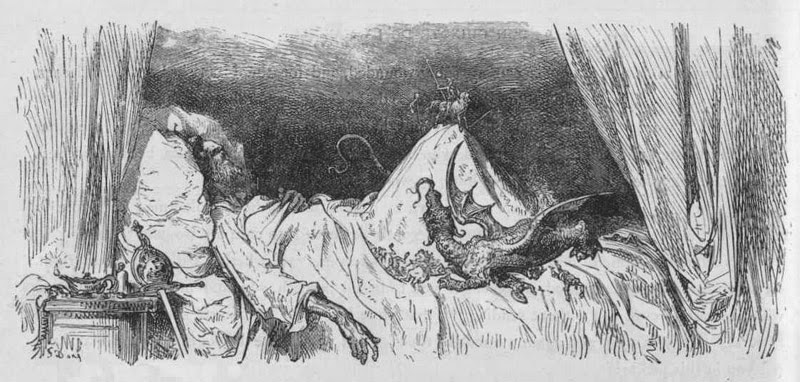
At last Don Quixote's end came, after he had received all the sacraments, and had in full and forcible terms expressed his detestation of books of chivalry. "

But it was a good fight to fail at; for, if man is anything at all, he is a zoon logistikon endowed with the power of the word to shape himself and his destiny through language, literature, liturgy and law.  The alternative is simply enslavement to mindless tribalisms.

Thus when the New York Times, decides to make much of the fact that Cardinal O’Connor’s mother was Jewish, despite the fact that O’Connor was oblivious to that fact and at no time in his life manifested any will to be Jewish, it is belaboring an accidental fact which is absolutely irrelevant to man’s freedom and which acquires significance only on the basis of racial-determinism.

The New York Times is entitled to pursue whatever cultural and political agenda it wants. But, for shame, it should stop at tribalistic exultations which impose an impersonal destiny on people against their knowledge, freedom and will. 


©WCG 2014

[1] Jabotinsky’s Letter on Autonomy, 1904. Cited in Brenner,  The Iron Wall: Zionist Revisionism From Jabotinsky to Shamir (London: Zed Books, Ltd., 1984), p.29.

[2] Mein Kampf, Vol I, Ch. 11.

[3] http://www.spiegel.de/international/victor-klemperer-i-am-german-the-others-are-un-german-a-341147.html

Friday, June 6, 2014

Two Creations & the Old Lie


Rather by chance, we came across Lully’s Marche Royale on Youtube which was gallantly pleasing as these marches go.   Far more impressive, though, were the accompanying video-stills taken from the Cathedral d’Albi, a late medieval structure in Toulouse, France built between 1287 and 1480. 


We were, it should be said, blown away by its beauty.  But the thought which recurred most in our mind was: hands — the myriad of human arms, hands and fingers that put this beautiful leviathan together.  


With each frame we imagined the backs that carried, the arms that cut, the hands that chiseled, the fingers that set and gilded the host of myriad details, each its own little soul, which joined in harmony to create this reflection of heaven on earth.


We imagined, also, the master masons drafting their plans late into the night, the surveyors measuring ground in the fresh of morning, the drivers and donkeys bearing cartloads of brick and stone to the site, the apprentices laughing and breaking for bread, onions and wine at noon... and of course, the accountants tallying their receipts and balances. 


There was more than mere architectural harmony at work here and the whole edifice made one rather disposed to forgive the human race its manifold follies, vices and crimes.


As fate would have it, however, this morning we came across another video —  a propaganda film made in anticipation of the D-Day landing in Normandy.


The film was mostly a paean to the united logistics that enabled the invasion.  It detailed with swelling pride the jeeps, the tanks, the planes, the rolling stock, the landing craft, the crates of supplies and murderous widgets, all of which were  “the fruition of four years of planning...”


And not least was the vast expense of human labor that so manifestly infused the entire enterprise on every point along the assembly line of war...


“...every man knew just where he was to fit into the gigantic pattern...   intoned the narrator,


“...every jeep every tank... was assigned its place in the grand strategy of attack...”


Every single piece of which -- from belt buckle, to rifle bore, to screwed in detonator, the work of human hands.

Two things such propaganda films rarely show are: drudgery and death — the sheer boring, exhausting, sweating, aching business of unloading 3,000 boxes, of parking 1,000 tanks, of standing in line waiting for something to get done, before some other tedium can slowly unfold; and, of course, the denouement of it all which consist in blowing concrete, earth and flesh to bits in a million moments of destruction, mutilation and death. 


And so, we were left to contemplate what might be called the Two Creations, each the inverse image of the other — one a reflection of what we hope is heaven, the other an embodiment of what we know is hell.

Today, June 6th, the leaders of the Allied Nations, together with sycophants from defeated Germany, gathered in Normandy to commemorate what is styled as the Liberation of Europe, but which would be more honestly be styled as the Great Destruction.

I wish to make very clear that I raise no objection to a penitential remembrance of loss and waste and suffering; and, in this regard, to remember that this remembrance includes the other side, as a 93 year old  English veteran struggled to remind us.

But the truer remembrance, in my view, is the one uttered by Wilfred Owens almost a century ago,

If you could hear, at every jolt, the blood
Come gargling from the froth-corrupted lungs,

you would not tell with such high zest 
To children ardent for some desperate glory,

The old Lie; Dulce et Decorum est
Pro patria mori.
When at least, as the Queen has always done, the remembrance is left to silence, no attempt is made to “bawl allegiance to the state” (Owens).  But once the speeching and preaching begins we are simply rehearsing the Old Lie. 


And this is what was done at the Anglican service on June 5th when the Army Chaplain, sanctimoniously intoned,

“for in the end, greater love hath no man than this, that a man lay down lay down his life for his friends...”

The problem with this statement (as we recently discussed) is that it is a sophistical canard which shuffles between the soldier as an individual and as a piece in the “gigantic pattern” of a country at war.

Let us return to d’Albi.  Does it matter that a mason, carpenter or glass-maker may have gotten drunk after work or beat his wife the day before?  Of course not.  His individual sin does not detract from the harmony of the work of the whole as a whole.  The cathedral remains a reflection of man at his best. 

Conversely, the fact that an individual soldier took heart in fear or threw himself down on a grenade to save his buddy does not redeem the vileness of the enterprise of nations. 

This shuffle between the one and the many which extracts from the pain, sorrow and heroism of individuals an insinuation of just cause for the many is the vial of poison used by preachers who whore themselves to war.

And no one whored himself better than Obama, whose  teleprompted remarks on the beaches of Normandy were a paradigmatic example of how the language of crusade is used to justify ongoing war.


After his trademark treacle about “the child who runs his fingers over colourful ribbons he knows signify something of great consequence,”  Obama went on to memorialize the sacrificial heroism of one Wilson Colwell, one Harry Kulkowitz, one Rock Merritt, and then rattled on to commend the present service of one Melvin Cedillo-Martin, one Jannise Rodriguez and one “sergeant First Class Brian Hawthorne” who “just yesterday, [ ] reenlisted in the Army Reserve."    These personal testimonials served as simple, tear-jerking buttresses to the real cathedral of Obama’s argument which was that

These men waged war so that we might know peace. They sacrificed so that we might be free. They fought in hopes of a day when we'd no longer need to.   ... We have to honour those who carry forward that legacy today, recognising that people cannot live in freedom unless free people are prepared to die for it. ...May  God bless our veterans and all who served with them, ... And may God bless all who serve today for the peace and security of our world.
In so saying, Obama honey coated the slipped-in assumption that we still need to wage war for peace today.  He was not remembering but advertising.  The solemnification Obama engaged in was a bawling praise of war tricked out in the Old Lie dulce et decorum est pro patria mori. 

The syllogism of the lie is always the same: you are laying down your life pro patria, for your friend, on behalf of others and, therefore, the war of which you were an exploited part was good.  Just as the lie confuses the motives of individuals with those of the State, it seeks to disconnect the act of war from its the inherent nature.

The issue is, in my view, fundamentally simple.  A person who engages in an assault does so for one undeniable purpose: to hit the other person.  The moment one says that the assault is committed for another purpose or for another person or for another concept, one has introduced a disconnect between the act and its ineluctable natural purpose.  Ulterior motive becomes the justification for what is actually done.  But this ulterior purpose bears no necessary relation to the act.  It is simply a tacked-on assertion.  This is the  syllogism of all crusades, the teleology of which Wilfred Owens categorically rejected. 

But once the commemorations at Normandy are seen as the reiteration of a crusade, we are brought to a discomforting intersection of the Two Creations.


The Cathedral d’Albi was built in the wake of the Albigensian conflict during which the government mounted a brutal crusade to suppress the Cathar heresy. In the aftermath of the bloodshed, the cathedral's dominant presence and fortress-like exterior were intended to convey the power and authority of the orthodox Christian faith.

In short, the awesomely beautiful cathedral was built to impress the locals with the magnificence and rightness of the imposed order of things; and, by implication, with the justness of the previous slaughter.

Here a further discomforting intersection arises; for the phrase often attributed to General Patton was first uttered on the eve of the mass slaughter of the Cathars. 


How to distinguish the Catholics from the heretics in the city? it was asked. "Caedite eos! Novit enim Dominus qui sunt eius" – (“Kill them all! The Lord discerns which are his”.)  And so,

"... crying "to arms, to arms!", within the space of two or three hours they crossed the ditches and the walls and Béziers was taken. Our men spared no one, irrespective of rank, sex or age, and put to the sword almost 20,000 people. After this great slaughter the whole city was despoiled and burnt, as divine vengeance raged marvelously.” (Letter of legate Almaric to Pope Innocent, 1209)

What would Almaric have said of allied carpet bombing? we wonder.   But it is certain that the slaughter of innocents, (which always seems to occur when we heroically and sacrificially die for fellow man) is a horror which requires a commensurate justification which is made as unquestionable as the slaughter it excuses.


The solemnities at Normandy and in Paris are not only a commemoration of the Allied Effort on D-Day, they are, more fundamentally, a solemnification of the post-war world order.  The war is fobbed off as a crusade, the unstated but absolutely necessary premise of which is that we were right and noble whereas the other side was dastardly,  shameless, heretical and consummately evil.  This is a post-war article of faith, which it is illegal and blasphemous to question in any way or to any degree because to do so would begin to question the Old Lie.


©WCG, 2014

Sunday, May 4, 2014

Chanting on the Cheap


In an idling moment, we came across Vatican Television’s broadcast of the 2 Pope Canonization Duo, last Sunday. It certainly was impressive to see the millions filling and overflowing Vatican Square, the Via della Concordia and beyond.


Adding to the impressiveness was the fact that the “crowd” included the royal and the grand from the Catholic world


There is something arch-typical in seeing a monarch curtsy.

Not so impressive, however, was the gastric-moaning cum muzak-angelicus which, since Vatican II, now passes for Roman Chant. 


This week's canonization began with a "new-chant" litany which can be contrasted with the one from the Sixth Century given below.

Now,  it has to be said that all religious chant is, up to a point, monotonous; for, that is what chant is: a mono-tone.   This is the result of what the poet Valéry might call le son et le sens of liturgy.  To the extent that liturgy entails a litany — or mantra — its purpose is to repeat an idea and focus the mind into a concept.  Kyrie Eleison, Christe Eleison, Kyrie Eleison is the most paradigmatic, if short, example.

10th Century Gregorian Chant

"Let that beautiful custom of all the provinces of the East and of Italy be kept up, viz., that of singing with great effect and compunction the 'Kyrie Eleison' at Mass, Matins, and Vespers, because so sweet and pleasing a chant, even though continued day and night without interruption, could never produce disgust or weariness". (Council Vaison, 590 A.D.)
--

In this case, mono-phonic repetition underscores a singular ideonic repetition so that one’s “presence of mind” becomes infused with a focal constancy from without and from within. 

Sixth Century Roman Litany of Rogation
Often a "pure" litany like the Kyrie is used as a refrain in a sequence of petitions or invocations whether in prayer or procession.

This is, perhaps, the fundamental  premise of chanting.  It is a form of meditation or dedication (giving of one's self) to a mental object.

Mozarab "Sanctus" (12th cent. Spain)

But all things imply or call for their opposites.   So it is, that the "monotony" of chant is infused with dynamic modulations and inflections which supply variation even if it is might not be heard at first.   The training scores of old Gregorian Chant sometimes contained worm-like squiggles over the notes, which served to indicate the increase, fullness or declension of the breath in the sound.   Without such devices chant would quickly become unsustainable.

Arabic Byzantine (Greek) Orthodox (Syria)

This general (and certainly non-technical) description applies to and audibly connects other species of chant within a common genre, be it Muslim


Muslim Call to Prayer

or Buddhist or any of  myriad other religious chants.


Thai Buddhist

But mantras are not everything.  In other liturgical situations the purpose of sound is to underscore and assist a narrative be it a creed, a confession, a prayer or an adulation.


Greek Orthodox Prayer

Here, the music has to serve as a fulcrum between the dynamic of changing ideas and the desire to maintain a stasis or  constancy of a psychological posture.

Russian Prayer

The “narrative” is limited by its own internal logic. For example a confession, which has as its core idea “sorry” will proceed to list the ways, manners and circumstances of transgressions.  Similarly a hymn of praise might list the ways and manners in which the deity is beneficent of magnificent.  There is both constancy and change.


At times the "narrative" will shift between core ideas. This often happens in the psalms which might begin with themes of shame or sorrow and end with praise and gratitude.  Here, both the sounds and the sense have to closely collaborate so as to produce a seamlesness of progression from one idea to its unfolding other.   In Platonic terms, music provides the ergon (energy or work) to the abstract logos of the ideas.  On might call it “opera” without jolts and surprises.


 19th Cent. Anglican Chant (Psalm 149 [Atwood])

From the Roman and Orthodox perspectives, "chant" is the official sacred music of the liturgy.  The ergon of tonality is secondary but integral with the logos of the text.   Together they comprise what can perhaps be called expression within a prescriptive discipline.   All other music  -- including Hayden and Mozart masses -- was regarded as popular religious music, allowable as appropriate in the way painting, sculpture and architecture also serve as tangible expressions of faith.


As is well-known, both the Reformation and the Counter-Reformation, sought to make a greater accommodation for "popular" religious music.   In the Roman ambit, the radical result was the polyphony of Palestrina.


Puebla Cathedral

Even more radical was the polyphony of Gutierrez Padilla whose Spanish roots and Mexican circumstances led him to produce something which might be described as polyphonic counterpoint with Arab or Aztec syncopations.   Depending on how he is sung ("slow" or "fast") his liturgical music hearkens back to Palestrina or points forward to Bach.   But from the perspective of chant, Padilla is a kind of playful folkish baroque.

Although incorporating popular singing into the liturgy was a core project of the Protestant Reformation, it is something of a myth that Protestants were off singing like happy frogs while Catholics were mumbling into their rosaries.  Both branches had full and rich repertoires of “popular” liturgical music which included the sublime B-minor Mass or Missa Solemnis as well as what can frankly be called religious commonplace, otherwise known as "familiar hymns". 

Nevertheless, the stereotype of protestant croaking versus catholic mumbling cannot be stripped of all truth.  The ordinary low mass, which formed the great majority of daily roman rite services, was spoken and not sung.

This stereotypical distinction arose from a theological divergence concerning the significance of the Eucharist. For Protestants, the Eucharist was a commemorative, communal meal in which Christ was present “spiritually” (whatever that meant) whereas for Catholics it retained the character of an actual sacrifice in which Christ was really present corporeally (whatever that meant). 

This divergence was reflected liturgically in the fact that just as the Catholic low mass “forgot” the music, low Protestant denominations forgot the daily, weekly or even monthly Eucharist so that the ordinary service became a species of weekly lecture accompanied by communal singing. 

After the World War, rectifying reform proceeded in earnest in both camps.  Anglicans in particular re-emphasized the centrality of the Eucharist within a by now rich and eclectic musical tradition.   After Vatican II, the Church sought to re-involve the laity in liturgy, and this, primarily, meant singing.  The reformers' over-riding imperative became,  “Sing Everyone Sing!”


However, this move to “update” the Church presented serious theological difficulties which remain unresolved.   Simply put: if the mass is an actual sacrifice of a living God, it must at least be something of an awe-filled event.  Strumming guitars and smiling-on-your-brother does not work.

I recall that when Vatican II’s reforms were going into effect, the seminarians down the road -- no doubt bored with  chant in the Beatle's Era -- strummed, clapped and swayed to a "pre-communion"  tune called Sons of God


The problem with what I dubbed the Werewolf Song is that it made explicit what is best left as a "signified mystery,” the prototypical expression of which is found in Saint Mark's account,

"And as they were eating, he took bread, and when he had blessed, he brake it, and gave to them, and said, ‘Take ye: this is my body.’  And he took a cup, and when he had given thanks, he gave to them: and they all drank of it. And he said unto them, ‘This is my blood of the covenant, which is poured out for many.’" (Gospel of Mark  14:22-24.)
 Earlier still is the reference to the Eucharist found in Corinthians, written around 50 A.D.,

For I received from the Lord what I also delivered to you, that the Lord Jesus on the night when he was betrayed took bread, and when he had given thanks, he broke it, and said, "This is my body which is for you. Do this in remembrance of me"  In like manner also the cup, after supper, saying, ‘This cup is the new covenant in my blood: this do, as often as ye drink it, in remembrance of me.’ (1 Corinthians 11:23-26)
Although both versions of the core account are similar and equally open to a metaphorical interpretation,  Saint Paul goes on to explain,

"So it is the Lord’s death that you are heralding, whenever you eat this bread and drink this cup, until he comes. And therefore, if anyone eats this bread or drinks this cup of the Lord unworthily, he will be held to account for the Lord’s body and blood. A man must examine himself first, and then eat of that bread and drink of that cup; he is eating and drinking damnation to himself if he eats and drinks unworthily, not recognizing the Lord’s body for what it is."  (Ibid 11:26-29.)

A hundred years later the doctrine of a transubstantial sacrifice is fully entrenched in Justin Martyr’s First Apology

"For not as common bread nor common drink do we receive these; but since Jesus Christ our Saviour was made incarnate by the word of God and had both flesh and blood for our salvation, so too, as we have been taught, the food which has been made into the Eucharist by the Eucharistic prayer set down by him, and by the change of which our blood and flesh is nurtured, is both the flesh and the blood of that incarnated Jesus" (First Apology 66:1–20 [AD 148]).
Thus, from the earliest New Testament accounts and received traditions, the Eucharistic core of the "Divine Service" was understood as something more than a meal-in-common, and certainly something more than a Mac Jesse Happy Meal.

There is nothing wrong with religious or commemorative communal meals, of which the Sabbath Seder is a prime example.  Its core idea -- the breaking off from work and the blessing and breaking of bread, wine and simple foods -- is versatile and portable, performable as much in hotel rooms as homes or temples.   One can add singing, dancing, discussing or jokes au gout. 

However, it is not clear that Christ was celebrating a typical seder at the Last Supper.  At all times, the religious core of the sabbath is to commemorate God's Creation, Israel's Redemption and to receive a "taste" of the Kingdom to Come.   With that context in mind, it emerges with fair clarity that, at the Last Supper, Jesus identified himself with those three concepts.   In other words, he was not merely "doing Passover" because (by the accounts given) he was changing the remembrance.

One need not celebrate the Eucharist weekly or daily, but to the extent that a Christian celebrates it, it is the commemoration of a solemn and existentially changing sacrifice, the nature of which, despite being disputed and explained, remains mysterious.  In the end, one is left with a forest of words around a central clearing.

What is also fairly clear, despite theological quibbles and evolving liturgical complexities, is that at all times, singing ended before communion with the Agnus Dei — the fifth and last “sung” part of the mass.

Lamb of God, you who take away the sins of the world, have mercy upon us.
Lamb of God, you who take away the sins of the world, grant us peace.
How one received the Eucharist, what it meant to one's heart of hearts was left to the quiet and emptiness of silence.  Bellowing out what is, at bottom, a material (and digestive) representation of an  spiritual mystery is a travesty.  If one truly believes he is biting down on the actual flesh of a living god does he sing a kindergarden ditty while doing so?  What kind of imbecility is that?  If one sings a doggerel ditty such as the Werewolf Song can he believe that he is doing anything more than having “milk and cookies” on Sunday?

This was the central problem with the “updating” reforms of Vatican II.  The more the updaters and relevancers surrounded the altar with the sounds and clapping of all-together-now singing around the “communal meal,” the more the transcendental mystery of what was supposedly a solemn sacrifice got buried under a heap of popular and usually ill-conceived noise.  At best, Catholic services became a self-conscious imitation of mainline Protestantism.   At worst -- and all too commonly -- service descended into treakle, kitsch and outrage. 

One of the ways the Church tried to back away from such liturgical doggerel was to put “chant” back into the mass.  But it was felt that real chant was too subtle and too complicated for “the average person.”  Accordingly, “chant” got stripped of its subtle harmonics and inflections so that it could be so that be sung by Ordinary Man.  The liturgical reformers hoped to retain something called “chant” as the official or core sound sub-serving the sense of the prayers while at the same time heeding the prime directive to make sure everyone sang. 

Anglican Chant was a 19th century attempt to achieve a similar result, amenable to the sonic structure of English and singable with relative ease by the layman.  But whereas Anglican chant can be said to have succeeded,  the "simplification" of Roman Chant has produced nothing but mind-numbing, ear- tiring, sing-song monotony.   If the "subtleties" of tonal inflexions and dynamic emphasis were what gave the mono-tone of chant its life, taking those subtleties out left nothing but a sonic corpse.


Although the instrumentalisation was probably not part of the above Christmas Mass, (at least one hopes not),  it actually highlights what is deadly wrong about this updated chant which is indistinguishable from the sort of "stuff" one might hear during a sentimental Hollywood Bing Crosby  Christmas saga. 

The reformers’ premise was a notion ill-begotten of professional arrogance and condescension.  Any dolt can sing chant, if he is trained.  The beautifully complex “polyphonic-counterpoints” of Gutierrez Padilla were sung by and for recently converted Aztecs for whom the musical genre was entirely new.  What is required are information and intent.   

There are people in the West who have chosen to pursue their spiritual pilgrimage into foreign faiths. They do so by way of a commitment to learn and observe the discipline  and practices of a non-Christian religion.  Would be Muslims will learn Arabic which is required to fully appreciate the Koran. American Buddhists do not expect to “chant” country-western sutras or line dance the om mani padme hum.  Why should it be different for would-be Catholics?

The reformers confused updating with dumbing down and accessibility with a subtler form of passivity which masked laziness under the rubric of easy participation. 

It is probably indisputable that our present culture has become musically illiterate.  By this I do not mean  that in some mythical by-gone era of meisters every cobbler understood music theory.  While it  is certainly true that music was almost a vernacular in Germany, Italy, Southern France, Spain and New Spain, the more important fact was that people were not deluged by a barrage of commercialized noise.  The absence of all-pervading muzak (and worse) allowed people to hear beauty when they heard it and hearing it to mimic responses.  The ear of modern man, in contrast, is dulled by such constant sonic abuse that it cannot hear the difference beauty makes the way a punch drunk man no longer feels the pain.


© Woodchip Gazette, 2014
.

Thursday, April 24, 2014

Resurrection in Review


Chipster is reading Resurrection by  Leo Tolstoy.  It is not a particularly good novel because Tolstoy uses his characters as vehicles for didactic points rather than developing them of their own accord.  But although the character development is flat, the novel is carried along -- toward Siberia -- on its story line, salted with quick-sketches of human-types and social vignettes used to make psychological or sociological points.

In this latter respect, Tolstoy is also somewhat dated, reflecting in his views that late 19th century "forward looking" mind-set which -- building on 18th century rationalism -- advanced toward social scientism; of either the Darwinian or Positivist schools, although Tolstoy himself espouses the latter.

This is not to say that Tolstoy is necessarily wrong, but only to remark that Resurrection will not provoke sudden and novel insights.  The story rather falls into the category of "oft said, but ne'er so well expressed." (A. Pope.)

Nor is this to say that Tolstoy's little lectures are not gems in themselves.  I have in mind his "prequel" to the Banality of Evil, which states in two pages what the belaboring Hannah Arendt drags out -- like a long column heading for Siberia -- for an entire verbose and tedious book.

Speaking of the prisoners he sees being led to transports and of the two who died of exhaustion, the novel's protagonist, Prince Nekhlyudov asks himself who is guilty of their deaths?  The judge who signed the judgment?  The doctor who certified their health?  The inspector who was told to assemble the men? 


"No one is guilty, and yet the men have been murdered by these people who are not guilty of their death.

"All this comes," thought Nekhuludov, "from the fact that all these people -- governors, inspectors, police offices and policemen -- consider that there are circumstances when human relations are not necessary between human beings.  . . .  All these men .. . seeing a man growing weak, gasping fro breath, would have led him into the shade, would have given him water and let him rest .. But they did not do this… because they thought not of men and their duty toward them but only of the office they themselves filled and considered the obligations of that office to be above human relations.  That is the whole of the matter.

"…all those people…are for the great part kind people, cruel only because they serve.

"Perhaps these governors, inspectors, policemen are needed; but it is terrible to see men deprived of their chief human attribute: love and sympathy for one another.  … [T]hese people acknowledge as law what is not law and do not acknowledge as law at all the eternal immutable law written by God in the hearts of men.  That is why I feel so depressed when I am with these people.  I am simply afraid of them. And really they are terrible, more terrible than robbers.  A robber might, after all, feel pity, but they can feel no pity...  That is what makes them so terrible. …

"If a psychological problem were set to find means of making the men of our time  --- Christian, humane, simple, kind people -- perform the most horrible crimes without feeling guilty, only one solution could be devised: simply to go on doing what is being done now.  It is only necessary that these people …should be fully convinced that there is a kind of business, called Government service, which allows men to treat other men as things without having human brotherly relations with them; and that they should be so linked together by this Government service that the responsibility for the result of their deeds should not fall on anyone of them individually. …"  (Bk II, Ch. XL.)

In short, Billy Bud.


{Au suivre}

Thursday, November 28, 2013

The Point of the Circle

     
Just as the circle is the perfect figure, so is Thanksgiving the perfect holiday.  It requires neither more nor less to be entirely satisfying. 

The heart of Thanksgiving and the all of it is simply feasting with friends.  This is the core of all religious commemoration, of all reconciliation, of all exultant howling around the carcass of the prey.

Thanksgiving entails none of the ego of birthdays or motherdays nor any of the impossible obbligatos of Christmas which more often than people will admit are simply a set-up for misery.

No.  Thanksgiving can be celebrated anywhere, with anyone with as little or as much as one has.  It is always good.


But the idea of giving thanks has always appalled me.  I can't count the number of times, while my host has rattled through a veritable laundry list of things he is thankful that God has vouchsafed to bestow on him, that i have wanted to add:

... and we thank you Lord, for the terrified animal whose pain and death has provided us with these succulent loins to savour; and that Thou, in Thy Gracious Mercy, have deigned not to number us among those starving children who are this night wandering streets and sniffing glue to stifle their hunger; and we thank You also, Oh Fount of Mercy and Love, that Thou has been so  very good to us, your unworthy but fortunate servants, that Thou has not let us fall among those despised and desolate, the truly blessed recipients of Your Grace....
The idea of giving thanks for accounted blessings has always struck me as an insufferable exercise of egotism wrapped in self-deluding and hypocritical humility, no different in spirit than the miser, gleefully counting his coins. Does anyone give thanks for suffering and going without? Saints perhaps.  

How is it possible to be grateful for having without necessarily being grateful for not not having? The catholic prayers a table which i dimly remember were always on the aesthetic side along the lines of:  "teach us to hunger after your spiritual blessings as you have given us food for our bodies..."  That at least was more of a cautionary reminder than an indulgent or indifferent reckoning.

Some may protest that life cannot always be so morose and i would heartily agree.  There are times to simply exult and be happy... and bringing in a harvest that yielded rather than not is one of those times too.  But being happy -- and limitlessly so -- is not the same as numbering one's acquisitions and successes.

What makes the circle perfect is that it points nowhere.


Saturday, November 23, 2013

Aftermath - The Vulgarity of Empire.

        
The morning after Kennedy was buried, the country awoke to find a stranger in its bed.  The indefatigable vulgarity of Lyndon Baines Johnson made unfavourable comparison inevitable.  As I.F.Stone put it,

"He is a sharp drop from Kennedy.  He has hardly read a book in years; never reads when he can help it; prefers to get information by ear, but rarely listens.  He is one of the most long-winded men in Washington... with a remarkably small stock of basic ideas....

"Money and power have been the motivating passions of his life.  He was a New Dealer when that was the road to power; he became a conservative when that was the way to stay in.  ...  He is the perfect extrovert,  with no convictions and a passion for getting things done, anything.  ... [¶]... His vanity, his thin skin and his vindictiveness make even the mildest criticism ... dangerous.  ...
"Johnson is not a racist or a reactionary. ... As a shrewd politician, he knows he must move slightly leftward and make civil rights his number 1 issue... if he is [to become more] than a Southern politician with a basically stand-pat philosophy.  ... The hope is that men change and grow.  The sense of role, the maturing effect of responsibility, the consciousness of duty and love of country, the sense of humanity and history, all have their effect.  ... There may be surprises in Johnson and we wish the new President luck."  (Vol XI, No. 24 12/9/63; www.ifstone.org)

The sting of Stone's portrayal gives it a taste of truth and he was right in his prediction that the "level of literacy and civilization will fall again, as it did after F.D.R."


But it is a tad unfair to subject public figures to too much light.  Men do not accomplish anything without power and do not get into power by being poets. Politics is the art of the sordid.

If Kennedy was -- as his ghost writer once put it -- the author of his poetry, it was only because his father, Joe Sr.,  had authored all the sordid deals for him.  Jack was untouchable because he hadn't touched a damn thing.  Johnson, a true nobody from nowhere, had to claw his way in and clawing is never pretty.

Johnson was a figure cut from Shakespeare, at once the bumbling peasant and the despicable overseer promiscuously out of place in the Court of Savoir Faire that did not know how.

And so, in a curious and indirect way, the country also awoke to an awareness of the stricken hero's imperfections. The whispered coda on everyone's lips was: "but maybe now things can get done."  Johnson stood for the drudge work of a dream Kennedy could evoke but not accomplish. 

It was Johnson who pushed through the Civil Rights Act of 1964 even if, as he said, it would be the act that destroyed the Democratic Coalition, which it did and which more than anything else enabled Nixon and Reagan to come to power. 

It was Johnson who pushed through Medicare which is the one program that keeps senior Americans from literally dying in gutters including those who once chanted "Hey, Hey, LBJ - How many Kids Have you Killed Today."

It was Johnson who enacted a slew of small social and economic programs which in small but real ways made the difference for small but real people.

It is unfair to excoriate politicians for impurity of motive as if they should do good without the slightest hint of egotistical drive or satisfaction.  No one can pass such a test. It was Johnson's misfortune that, following upon the pseudo saintliness of Jack Kennedy, his ordinary vices and even his virtues appeared for the worse.

Beneath the vulgarity and ambition Johnson retained simple but humane instincts.  He really had wanted to bring rural electrification to Texas and he really did want to make the United States a more fair union. 

The tragedy of Lyndon -- and it was a tragedy --  was that he had embraced power with the notion of doing something good and found that Power had embraced him for her own ends. 

Johnson might fix and finagle things in what I.F. Stone called "the decayed underside" of the U.S. Senate.  What  Johnson could not fix was the decayed underside of Kennedy's lofty Inaugural Address.   Vietnam was the pustule of America's status as a world power.  The war was no more avoidable than America's chosen "manifest destiny."

The unending slew of homiletic pieties which passes for American rhetoric has convinced us that America is a basically good and decent land which from time to time makes atrocious mistakes.  Rubbish.

Ever since 1776, when the Colonists revolted against the Quebec Act which had forbidden westward expansion (and which Jefferson denounced as inciting the "merciless Indian Savages" against us), the country has been about expansion and empire.  The endeavour reached its culmination in 1945 when the United States stood astride a devastated world which it more than anyone else had blasted into rubble.  Americans are wont to think of themselves as liberators but such self-massaging is one thing that doesn't gratify beyond our shores.  Any European understands that the United States no more liberated Europe than Rome liberated Greece.

With the success achieved in 1945, U.S. policy became one of consolidation and extension.  The aim was to erect a cordon sanitaire around the Communist world (what Churchill, in a delirium tremens of deflected accusation, called the Iron Curtain) and then to foster what were called "zones of democratic freedom" in the no-man's land of the "third world."  The Cold War consisted in ongoing skirmishes over "push points" in the Congo, Cuba, Laos or Iran -- outposts, colonies and satrapies tied to one or the other of the blocs by "shared values" and trade.

Five decades later, all that really changed was the unvarnished candour with which the policy got stated.  The aim of Dick Cheney's doctrine of ongoing "power projection" operations was to "preserve and extend American preeminence" and "to secure and expand" “zones of democratic peace;” "in line with American principles and interests."

The unvarnish was inadvertent. It resulted from the fact that, after the fall of the Soviet Union, there was nothing left to contain and the U.S. could no longer cast itself in the shining armour of freedom's guardian.   Thus, the essential thrust of NeoCon doctrine was a colossal "Who Gives A-Fuck."  America was top dog and would stay top dog by kicking ass around the world. Containing Communism transmuted into Maintaining Preeminence. 

It is pointless to ask whether John Kennedy would have gone that far.  The answer is, no; but only because Kennedy was not president that far along on history's trajectory.  It is a different question altogether whether Kennedy would have seen the "need" to "contain and push" in Vietnam.  The answer is, yes.

It is worth remembering that it was Kennedy who first institutionalised the use of "full spectrum" forces and "special operations."  That was what the Green Berets were all about, even if they were decked out as some kind of uber-athletic bivouacking team, replete with their own best-selling, pre-Weider,  fitness manual. 

Vietnam was the first muddled test of the new strategy.  It began with black ops (an assassination) was carried on by "pacification" programs (the murdering and concentration of entire villages) and ended in all out aerial and chemical bombing short of nuclear war.
 
Vietnam was a "necessary" war because (as Kissinger would later say) it was necessary not to be perceived as weak -- in other words to be seen as ever-ready, ever-eager to project power.  That was the entire dynamic of the post-war construct.

The notion that Kennedy was back-tracking from engagement in Vietnam is too pretty for words. It was Kennedy who had loftily intoned that we would "pay any price, bear any burden, .... oppose any foe, in  order to assure .... the success of liberty."  His administration was already implementing the play-book Johnson would continue to use.  To think that Kennedy would call the whole thing off two years later, one has to believe that Kennedy would have ignored the very same cadre of cabinet officers and advisers who stayed on to advise Johnson.  It is possible but not probable.

Even to say as much erroneously presupposes that leaders exist independently of the forces that thrust them forward and sustain them.  They do not. As President of "the most powerful nation on earth" Johnson had to serve the cause of power once in power himself.  There was no way out from that  Faustian embrace and he was just as trapped as Kennedy would have been.

The difference between Johnson and Kennedy was that Saint Jack would have let loose a noble and inspiring War Whoop which would have had an entire generation marching off to war under fluttering flags instead of half of it being surreptitiously shipped off to slog around in rice paddies while the more privileged half sloshed around in mud-fields protesting and what-not.

At bottom, Kennedy was a jock.  Although he had the good sense to keep it within limits, he relished a good fight.  As he said in his Inaugural,

Only a few generations have been granted the role of defending freedom in its hour of maximum danger. I do not shrink from this responsibility – I welcome it.

For all his physical presence, Johnson never spoiled for a fight.  Some said he was a physical coward.  He had lusted for power with the idea of improving the lot of poorer Americans.  Vainglorious as it might have been, he did want to go down in history as the Great Benefactor of a Great Society. 


Caught between the demands of power and the empowering of his dreams, Johnson pursued an ambivalent course.  The disaster of his "guns and butter" policy was that it succeeded at neither and drove a permanent wedge into the country between those who got the guns and those who got the butter.  That was something Kennedy would not have permitted.

But Kennedy's crusading spirit did not mean that the war would have ended sooner or bankrupted the country less.  The war was unwinable because it was the kind of war that cannot be won, even by Green Berets!  Only conventional wars have conventional endings.  The idea that you can "win" an unconventional war is an oxymoron because there is no one around to admit defeat.  The best one can do (as was said of Rome) is to "create a desert and call it peace."

It would take U.S. policy makers 40 years to realise that it did not matter if you won or lost because power projection was an end in itself.  But in 1964 U.S. policy makers were still tied to the tinsel of "democratic values," to the notion that nation building mattered and to the idea that "winning" (over what was not very clear) was a possible outcome.

Was it possible to alter the historical trajectory the nation had embarked upon in 1776?  No; and no one wanted to.  But Kennedy had led us to think that our undoubted preeminence could be used for good,

To those people in the huts and villages of half the globe struggling to break the bonds of mass misery, we pledge our best efforts  If a free society cannot help the many who are poor, it cannot save the few who are rich.   ....  [T]he trumpet summons us again– to struggle against the common enemies of man: tyranny, poverty, disease and war itself.

It was stirring stuff. The Inaugural  beckoned to the idea of a beneficent empire.  It was America's Ara Pacis -- a New Rome uniting the Free World within New Frontiers of peace, progress and prosperity.  We thrilled to the challenge and thought it possible.

But despite the friezes and phrases, no empire is beneficent because the essence of empire is exploitation.  There is no such thing as "gentle power."  Empires are what they are and they exact their price from rulers and ruled alike.

Kennedy was the noble fraud, the way we wanted to see ourselves.  Johnson was the ugly truth and we hated in him what we did not want to acknowledge about us.  His tragedy will be ours.

©WCG, 2013