Sunday, January 17, 2010

A Dream for Elena

I found myself in Venezuela-Gaza, standing on a hill in Jerusalem from which the path ran down through narrow old streets that turned into a modern jumble of hillside favelas and a plain view of urban disparities.

A group of student volunteers were meeting up in a cavernous rectangular hall dating from Crusader times and were discussing things as they got ready to adjourn. Leaving them, I walked out into the surrounding narrow grey stone streets that coursed like channels between walls of shops with colourful open displays .

There, I ran into Elena and her baby. Elena was sick, with some respiratory ailment. The baby too was sick, but his biggest problem was that he had no milk.

What to do? I talked to Elena. She was full of what at first sounded like excuses but which on closer listening were true statements of why she couldn't do anything, why her situation was helpless and hopeless.

I did some work around and got her either some medicine or some milk or something to cover herself with in the cold. She took it with a mute and fatalistic appreciation that bordered on indifference.

I went back to the gathering, and somehow discovered that Chavez had started a milk program. Everyone one in Venezuela would get milk! Five glasses for children, 1 for adults, and 2 or 3 for old people. It was right there, in black and white, on the form next to the check-boxes.

I ran back to Elena and told her about the milk program. The only thing was that she would had to pay a nominal sum -- in her case .32 cents -- in order to "qualify" for the milk grant. Elena was appreciative, in an empty way, for what was in fact an empty gesture. Yes, but she still didn't have the money or at least not enough to do it daily; so in the end what was the use? In the end it was hopeless.

I stood inside the ante-chamber of my gyms' sauna. In Spanish, a nurse-voice said. "It is critical to get to her now. If we get to her now at this stage we can do something, otherwise her condition will become chronic, even if we were able to manage it."

I went back to my room and wrote a letter/speech to Obama. It was the perfect letter distilling the truths of what had to be said and setting them out with clarity and convincing force and with no more nor less than what had to be said.

An aide tried to run interference, but I folded it length-wise and got it into Obama's hand. "Read it," I said.

A short while later, Obama convoked a re-gathering of the young volunteers. He told them that there were three alternatives:

The first alternative was denial; to negate the reality, with some sort of countering polemic.

The second alternative was to admit the reality and the need for change, but (as he hunched a little and ducked his head to the side) to "realistically" acknowledge our limits and do what we could within our limits.

The third alternative was to admit that one had been wrong, without varnish and rise to meet the reality without compromise

The No. The Yes But. The Yes!

The audience was more than enthused. I was overcome and crying. Elena and her baby were going to be alright. There was going to be a real change from now on out. I was crying for joy.

As I returned to my college dorm room, someone came running after me. Did I hear the speech? he asked excitedly.

"Yes," I said... "I wrote it."

"What?" came the reply, "Aw c'mon... don't be an asshole."

"No really," I said, as I fished out my copy, unfolded it and gave it to him.

In my dream I felt myself waking up, and I was happy for the new day I was waking up into.

Then I woke up.

-0O0-

We can always dream. but dreaming is not enough. We have to act on our dream, and therein lies the power of the pen.
.

©WCG, 2010

Thursday, January 14, 2010

An Apparent Economy.


Chipsters were never very good at algebra, but we excelled at geometry and, consequently, astronomy which, as everyone knows, is simply geometry in motion. We were particularly fascinated by Ptolemy, that genius astronomer of the 2nd Century whose great work, the Almagest, plotted the heavenly motions of planets and stars and whose calculations were so accurate they continued to be used by seafarers well into the 19th century.

Ptolemy introduced into my 17 year old mind a distinction I had never thought of before, or if I had, not very clearly. I knew that things could be disguised; that is, made to look like something they were not -- that after all was the whole point of Halloween when we chipsters scampered around the neighborhood dressed up as a human beings. But it never occurred to me that something could be other than what it actually was. For this stunning concept, we must thank Ptolemy.

Of course, as everyone knows, Ptolemy decided [yes, it was a decision] that the Earth was at the center of the cosmos and that the sun, planets and stars revolved around us. But that wasn't half of Ptolemy's genius. He also decided that since the circle was the most perfect of forms, the sun had to revolve around the earth in a circle. This made perfect sense, and from this premise, calculating where the sun would be next Tuesday would be a simple matter of counting the degrees per day around the celestial clock.

The only problem was that the sun was not where it was supposed to be next Tuesday. No, it was a little bit behind. To make matters worse, the following Friday, the sun wasn't further behind, but had mysteriously advanced forward by half a degree or so. The sun was playing games.

Ptolemy scratched his head and then had the stroke of genius, for which he will ever be remembered and honored by Man. He decided [sic] that there was a "real" sun which moved in a perfect circle, and a merely "apparent" sun which we saw to be further forward or behind and which moved in an epi-cycle around the circle.


As the epi-center moved around the center, the sun moved around the epi-center and this device explained not only why the sun was where it only appeared to be, but also enabled us to accurately predict where it would not really be.

Ptolemy called this "Saving the Appearances" and with ever increasing complexity and ingenuity he saved the appearances for all the planets and, in fact, for the entire cosmos.... at least the apparently visible one.

The Almagest is full of phrases like the "true sun" and the "apparent sun" or the "mean Venus" and the "actual Veuns" the "recession" of the Equinox and the like. I don't know who it was who decided that the "simplest proof is the most elegant." Ptolemy's proofs are far from simple and they are the very paradigm of elegance. Next to him, Copernicus and Kepler are dull, dull, snore, CLUNK.

Everyone should be required to study Ptolemy in order to understand how a premise will dictate a result and how a theory will self-validate and yet, from a certain point of view, be entirely wrong. I say this without intending to cast the least aspersion on Ptolemy for whom I have the greatest admiration and a certain affection. The problem concerns what we know, and how.

Given my background in astronomy, it is hardly surprising that my curiosity was pricked three years ago when a friend of mine, who is an investor, started complaining about how no one was talking about the "real economy."

"Real economy?" I asked with raised eyebrows. Was somebody ... Paul Krugman perhaps? ... out there saving the appearances?

"Yes, the real economy," my friend said with vehemence. No one has caught on that there are TWO economies out there: the corporate economy and the economy for the rest of us.

Gary's point had all the elegant simplicity of an epicycle, and it was, in fact, nothing very complicated. The government counts corporate earnings as part of the country's GNP. So, for example, if GM's profits are up, since GM is an "American" corporation, that contributes to the boost in "our" economy. But suppose, GM's earnings are up due to investments and earnings overseas, say for example, in China? How does this "boost" anything back home in the United States? GM isn't even required to deposit its profits in American banks, but can salt them away in a box in Dubai. What has any of this to do with you and me?

Nothing! Gary said, with a grousing air of annoyance before going on to belly-ache about the falsehood of labels and how "American" corporations were allowed to import duty free products apparently manufactured in China because they were really "made in the U.S.A."

For three years, my friend has been complaining about the economic fraud being perpetrated and about a press that aids and abets corporations that are literally gutting the country alive. Starting six months ago, Gary began complaining that corporations were "now" even shipping their capital overseas. "Soon there will be nothing left! And Americans are too damn stupid to see what is taking place right under their noses."

We at the Gazette have done our part, and have passed along Gary's wisdom to the High Mucky Mucks at the Times and other pillars of the Fourth Estate; but to no avail. Like Henny Penny's more optimistic cousins, the press runs about headlining "Corporate Earnings are Up!!!" "The Recession is Bottoming Out" ... before going on to say, without really thinking much about it, "although 'it is expected that' it will be a jobless recovery."

Oh, rejoice. "Yes, we have no bananas."

Finally, the other day, Robert Reich, who is at least as savvy as our friend Gary, published an article in which he acknowledged that what was good for GM was not necessarily good for America. In an article entitled, The Bad Job Numbers and the Secret Second Stimulus Reich writes,

"American companies are more profitable, to be sure. But there’s a massive disconnect between profitability and employment."Link

Meanwhile, GM's CEO announced cheefully, that the company had turned the corner, that profits were expected to be up, and that the stodgy Buick was selling like hot cakes in the booming middle class market in China. Of course, the UAW took it in the nose on health care and pensions, but hey, the Recession is over! We have positive GNP.

Since the end of the World War, the U.S. has been a fabulously rich country; and it still is, if capital assets are counted. But everything is finite, and anything can be depleted.

Robert Reich calls for more "stimulus" spending to create jobs (at home). But that is no longer a viable solution, particularly under Obama, whose Neo-Trickledown© economics [ here ] have simply consisted in throwing public money at private corporations without strings attached. (It's called "hope" ...dude.) It is too late for that. What is needed is outright nationalization of corporate assets so as to keep them here and repatriation of jobs which have been exported overseas.

Most people have realized for at least a decade if not more, that the U.S. was shipping its productive capacity overseas. But they suffered a disconnect in not seeing that this ultimately impacted on national wealth. It was simply taken as axiomatic that if cheaper overseas production boosted corporate profits at home that was "good for America." How so? According to Clinton, America benefitted by being turned into the world's financial file cabinet as Americans were "retooled" for "good paying jops" in the paper-shuffling "service sector".

Well it did not work out that way, and even in terms of trickledown, there was real trickledown (the kind that led Henry Ford to pay his workers $5.00 a day) and apparent trickledown (the kind that witches and wizards like Greenspan conjured up from their bubbling cauldrons).

We are being gutted under our very noses, and still the country does nothing. It is more enthralled by the Leno-Conan debate over who will reign in our insomniac hours.

Ridet et moritur. Ridet et moritur.

.

Tuesday, January 12, 2010

Fathomable Contexts


According to Ha'aretz, film director, Oliver Stone has the world "up in arms" over a new documentary that tries to put Hitler and Stalin -- the Evils of Evil -- into context. "You cannot approach history unless you have empathy for the person you may hate," Stone is reported to have said.

Stone is perfectly right, which is why I've always said that most of what passes for history -- "Hitler" included -- is myth. Manichean myth, in fact. As I result, I usually end up provoking gasps of incredulity as I reproach the unassailable and defend the indefensible.

Why, just the other day I rode to the defense of Stalin. I forget exactly how the topic came up, but a friend of mine made a remark that just assumed that Stalin was rock solid, certain "bad".

"Whoooa... wait a minute, wait a minute," I said, "you gotta put things in context.... Stalin was a great man."

Arrested silence.

Stalin faced a cruel, historical choice. It is usually said that Russia was "medieval". No such luck. What we call "medieval" was pre-national but certainly not primitive or incompetent. In all respects, medieval Europe had a vibrant cultural and economic life that involved most of civil society. As for dumb serfs -- what civilization doesn't have dumb serfs? Russia, on the other hand was lumpen. One ought not to exagerate here, either, but on the whole, Russia subsisted in a pre-industrial, pre-urban state ... one that was enviously rich in natural resources. What was a despot to do ?

Russia was flanked by industrial power houses whose economic engines demanded resources. And behind these lay Britain and the United States, always hungry for a bargain anywhere. The expedition to Archangel had shown what they could be counted on. If only for her own defense Russia had to bring herself up to industrial snuff. But not only for defence. If the masses of Russians were to be lifted out of the bog of their existence, what alternative was there but to become like Germany, the United States, France, England?

However, each of these countries had had at least two hundred years for their "industrial revolution" to unfold. Only an imbecile would think that this revolution unfolded without leaving a trail of intense human misery... of five year olds turned into cart-hawling beasts of burden in mine shafts, of women physically wrecked at 20, of millions working 16 hour days and eating bread adulterated with alum. These hardships were spread out over a century or more, and so appear to be less intense -- but they formed a Gulag of Misery all the same.

The Soviety Union had to.... well.... take a Great Leap Forward and accomplish in decades what had taken the West centuries. Of course the misery was intensified. And not just misery. What the so-called Industrial Revolution actually required was a massive accumulation of surplus value. The working class was not reduced to foul and fetid levels of subsistence out of some sort of spite, but rather because that is how the capitalist system acquires "wealth". Wealth -- which manifested itself in the store fronts of vast warehouses of commodities -- had to be squeezed from somewhere. Thus, the cruel paradox for Communist Russia was that in order to modernize she had to pack 200 years of capitalist squeezing into 20.

Still, it was an astonishing achievement; and beyond astonishing when it is taken into account that the entire process was devastatingly set back by the Nazi invasion which levelled most Russian cities, scorched the country side and killed 20 million people. And still, 15 years later, Russia beat the U.S. to the punch and put a satellite into orbit. And in order to do that, Soviet Russia had to create from the nothing of ignorance and superstition an at least technologically educated working and managerial class.

When we take a step back and contemplate how the Congress of the world's wealthiest nation has quibbled and fumbled and managed not to provide universal health care to its citizens, Stalin's achievements are breathtaking.

"Leave it to you....." my friend laughed.

Well, this was not to deny that Stalin was something of a psychopath and that his system committed monstrosities. Nor is it to deny that much of the glittering material progress was spiritually hollow and environmentally devastating. It was only to put things in context.

As if by coincidence, the woman who had sheltered Anne Frank, died the other day. Needless to say the English speaking press carried the story, along with detailed accounts of how the Frank family had almost survived in hiding against "unfathomable evil" as the New York Times put it with an air of self-evidence.

"Unfathomable...." If something is "unfathomable" it cannot be comprehended or thought about; and if it cannot be thought about, it cannot be learned from but can only be trembled at in mute stupidity. That is not the path toward progress.

.


Saturday, January 2, 2010

Oh, Those Wacky Keystone Prosecutors


Leave it to Washington to end the year with a farce, as U.S. District Judge Ricardo Urbina in Washington ordered the dismissal of an indictment against five Blackwater Worldwide security guards accused in a politically charged 2007 shooting incident in Iraq. [ Report ]

Most of the press reported the story as one of prosecutorial bumbling. The creme de la creme of the Justice Department had stumbled and fumbled into compromising the Government's case by using the defendant's statements in violation of the Fifth Amendment. Sanction time!

But Judge Urbino's findings, upon hearing, were a little less comic. He found the prosecutors' explanations of their conduct to be "inconsistent," "extraordianary" and "implausible" Significantly, he did not say "off the wall."

"The only conclusion the court can draw from th[e] evidence is that ... the trial team purposefully flouted the advice of the taint team when obtaining the substance of the defendants’ compelled statements, and in so doing, knowingly endangered the viability of the prosecution.
In other words, the District Court found that the Department of Justice had thrown the case

Throw a case against Blackwater? How could this be? The answer reveals the nature of the dark comedy that passes for American Justice at the turn of the millenium.

As anyone who has ever watched a COPS show knows, the Constitution prohibits self-incrimination and neither police nor prosecutors can use statements made under duress or compulsion. No Miranda? Case out! Next!

Whoa! Not so fast. Almost immediately after Miranda was decided, the Court began back-pedalling, as the Burger and Rhenquist majorities conjured up every possible exception, limitation and defeasing circumstance they could think of. One such "exception" was the so-called inevitable discovery doctrine, the essence of which is stunningly simple: Hey, if the incriminating evidence would have been discovered disiregardless of the defendant's statements, who cares?

Who indeed? Not the Court.
Lawyers now had a new sand box to play in, as the courts fashioned rules, standards, and thresholds for determining independent inevitability.

While the Courts were coming up with creative ways to protect themselves from tainted confessions, Congress was busy passing laws requiring government agents and contractors to give full and honest accounts to their debriefers following any screw-up, malfeasance, scandal or crime. After all, it was important for the Government to get to the root of the evil, whatever it might be, in order to fix it. And this required full and candid and fearless disclosure by those most intimately and, dare we say, criminally involved.

But suppose whatever it was that was being investigated did involve criminal conduct. It was fairly obvious that statements made to investigators under threat of loosing one's job could not be considered "voluntary". (Garrity v. New Jersey Jersey (1967) 385 U.S. 493.) So then, did confession bar prosecution? For a moment the Government looked confused.

The Court was quick to help out. In Kastigar v. United States States, (1971) 406 U.S. 441 it turned to the inevitable discovery rule and held that, in cases involving administrative debriefings, a criminal prosecution could proceed if the Government proved that it made no use whatsoever of the compelled statements or that any such use was harmless less beyond any reasonable doubt. Enter "taint teams".

Obviously an investigator or lawyer who was aware that Jack had confessed to killing his girlfriend at 2.00 a.m. on a lonely back road in the wilderness of Montana after the two met up at the world's biggest most crowded mall in Winnepeg would have a hard time investigating the case from scratch without ever taking a "lead" from the confessed facts he was aware of. And so, in inimitable bureaucratic fashion, the Justice Department set up teams of lawyers whose job it was to keep other teams of lawyers in the dark, so that they could discover the truth by their own unaided lights and meet their burden under Kastigar.

One would have to be a veritable Pangloss not to realize that Government had managed to set up a double layer of protection for malfeasance in public service.

There may indeed be situations in which government has a bona fide interest in discovering the whys and wherefors of some systemic failure. Investigating "unauthorize killing" in occupation zones is not one of them. It is the height of bully boy cynicism to put on choir boy stoles and claim that a full and broad and detailed confession by Blackwater guards was needed in order to "understand" the "effectiveness" of our own rules of engagement.

The whole exercise simply allowed the guards to craft a confession-cum-defense that would heighten the difficulty of "inevitable discovery" of any key fact needed for conviction. And anyone who does not believe that Blackwater guards received "debriefing-instruction " as part of their training is a fool.

But Blackwater is the Government's darling. To make ultra-sure that no prosecution would ever see the light of day, the government's "taint team" spilled ink all over the damn place and in case that wasn't enough the "prosecution team" ignored whatever pro-forma or face saving "warnings" and "advices" the taint attorneys did deliver.

The Justice Department would have us believe, that their top attorneys on a high profile case were just a bunch of Keystone Prosecutors missing one another and bumbing into eachothers behinds. The whole thing falls into the category of Lucius' "boating accident" in I Claudius.

Is there anything in Washington that does not raise a stench to Heaven?

.

Monday, December 21, 2009

Occluding the Season


Someone on a chat-channel pasted a link to a David Duke diatribe on how "the Jews" were effacing Christmas from our national consciousness. As might be expected, the polemic suffered from overdrawn inferences aided by material omissions. Moreover, it was not clear to me that Duke's Christmas tradition was not simply a Disneyfied version of German-English holidays which didn't leave much room for equally Christian traditions of other sorts.

However, in one factual respect, the report was correct: Rahm Emmanuel, accompanied by two Chabad Lubavitch rabbis in black, had lit the "National Menorah" on the White House Ellipse.


National Menorah? I had never heard of such a thing and I certainly have never seen a Jumbo Candelabra on the White House lawn. Where have I been? When did this start?

According to the AP, the National Menora "tradition" began 30 years ago when Jimmy Carter "attended" a lighting of Hanukkah candles in 1979.


Well... someone at the AP is overstating a case. What Carter did was attend a low key, privately sponsored ceremony -- much in the way presidents munch on ethnic foods and issue commemorative proclamations on the occasion of some hyphen-American holiday. It all fell into the category of ribbon cutting in the Kumbaya State.

The White House archives confirm as much, stating that "many Presidents" -- i.e. Carter, Reagan, Bush, Clinton -- "have participated in lighting ceremonies marking Hanukkah." However, 2001 " marks the first year a Hanukkah lamp (a menorah) was lit in the White House residence" by President Bush-II and attendees.

In other words, the 30 year "tradition" boiled down to a president toodling off somewhere to light some candles. It was not until 2001, the candles were brought to the public space of the White House, and even then, the ceremony was conducted behind closed doors.

With good reason too, since "one of the oldest symbols of the Jewish faith is the menorah, a seven-branched candelabrum used in the Temple." (Jewish Virtual Library - [here] ) By any standard a public presidential validation or endorsement of a ceremony symbolizing a "faith" would violate the Establishment Clause.

So how is it that a sectarian religious symbol which also doubles as a foreign national emblem gets erected on the nation's Capitol Mall?

The argument trucked out along with the menorah is essentially one of "equal time" -- if you Christians get to light up your tree, we Jews have a right to light up our candlestick. This was the argument put forth Rabbi Elazar Bogomilsky with respect to airport Christmas trees. Contrary to David Duke's polemic, Rabbi Bogomilsky did not demand that the Christmas in the SeaTac airport be taken down but rather "requested that a Hanukkah menorah also be displayed" [ Seattle Times ] Bogomilsky is also a member of the orthodox Chabad-Lubavitch, sect which has evidently set for itself the mission of promoting an equal but separate icon.

The promotion rests on the fallacy that the Christmas tree is a religious symbol. It is not. Whatever religious significance it might once have had in the pagan forests of Germany, the Christmas tree is no more than a cultural motif. And a rather universal one at that.


It would be difficult to argue that a Tannenbaum which once graced Soviet era not-Christian Christmas cards constitutes a peculiarly and specifically Christian symbol. In fact, the U.S. Supreme Court has so held, which is precisely why a Christmas tree is allowed on the White House lawn, whereas a Nativity Scene is not.

In contrast to the absence of bishops or cardinals attending or blessing the the lighting of the National Tree, the lighting of the National Menorah has always been conducted by and in the presence of rabbis.

Of course, as with almost anything Jewish, the Menorah has a dual character. Thus, the same Jewish Virtual Library which describes the Menorah as a symbol of faith, goes on to state in a separate article that the lighting of menorah candles on "Chanukah is not a very important religious holiday." The celebration arose from the super abundance of lamp oil which miraculously appeared during the siege of the Second Temple by King Antiochus IV against the Maccabees "a religious traditionalist group" who had joined forces in a revolt against [ ] the assimilation of the Hellenistic Jews and and oppression by the Selucid Greek government."

Even here, a religious motive and a spiritual miracle are assigned to the menorah symbol. But, stripping the object of all possible religious connection, what is left is a symbol of a national uprising against foreign domination -- a sort of Jewish Cinco de Mayo.

One is left to wonder whether we will soon see the lighting of the National Sombrero on the Ellipse as well.

What is ironic, if not galling, is that an object which symbolizes apartness and a rejection of assimilation should receive public validation under the rubric of "inclusivity". While it is certainly appropriate for public officials to give recognition to the distinct and separate traditions and heritages that make up the American tableau, it is quite a different matter to elevate one of those symbols into a national icon. In fact, given the Menorah's non-religious role as the symbol of a foreign nation state, it is hard to see what justification could exist for erecting it, in that or any capacity, on our nation's Capitol Mall.

On the other hand, despite its name, the Christmas tree was and remains an appropriate national symbol because it is religiously neutral. As noted, a decorated tree is an object that has been adopted the world over as a motif for end-of-year celebrations, of all hues. In the United States, the decorating of a Christmas tree is a festivity engaged in by virtually everyone and by virtue of that very commonality (Jews included) is appropriately a symbol of all of us during this Season.

The hoisting of a menorah on public space is an artifice that seizes upon the inherent ambiguities between culture and religion. Traditionally, virtually all of a society's culture flowed from religion. Even where a cultural artifice had a material or economic origin, it was inevitably "spiritualized" and became imbued with a religious significance or, at least, connection. Since the close of the 19th century, the dynamic has flowed in the opposite direction. Originally religious motifs have been secularized and, under the "scientific" aegis of sociology religion has been reduced to an aspect of culture. The Supreme Court has struggled to implement the Establishment Clause within these ambiguities.

The more or less traditional legal rule set forth in Lemon v. Kurtzman (1971) 403 U.S. 602 was that the Establishment Clause prohibited "entanglements" between Church and State. The rule recognized that in the modern state, strict separation between the government and anything was impossible. In sociological fashion, the Court interpreted the clause in light of its supposed "function" and held that state action (1) have a secular legislative purpose; (2) must not have the primary effect of either advancing or inhibiting religion and (3) must not result in an "excessive government entanglement" with religion.

The issue was more or less simple so long as at issue was whether the government was funding lunches or textbooks in parochial schools. But what about a Nativity Scene on the steps of City Hall?

In Lynch v. Donnelly (1984) 465 U.S. 668 the Court ruled that the issue depended on the "setting". Where the creche was simply part of a larger display of non-religious cultural artifacs such as "a Santa Claus house, reindeer pulling Santa's sleigh, candy-striped poles, a Christmas tree, carolers, cutout figures representing such characters as a clown, an elephant, and a teddy bear, hundreds of colored lights, a large banner that reads "SEASONS GREETINGS," the Nativity Scene lost its religious character and its erection at a minimal cost of $200.00 could not be regarded as involving excessive entanglement or as having the primary effect of promoting religion. After all, the State funds art museums, which are chock full of religious paintings, and

"whatever benefit there is to one faith or religion or to all religions, is indirect, remote, and incidental; display of the creche is no more an advancement or endorsement of religion than ... the exhibition of literally hundreds of religious paintings in governmentally supported museums."

The issue came before the Court again a few years later, County of Allegheny v. American Civil Liberties Union, (1989) 492 U.S. 573 when the court was asked to rule on the constitutinality of an "equal time" Menorah / Manger / Tree display on city property.

The Court had little difficulty with the creche. It ruled that the Nativity Scene was essentially and unavoidably religious in nature. But, unlike the multi-cultural setting in Lynch, Allegheny's creche stood alone. Its isolated display on public property -- not connected with any other cultural exhibit -- constituted a public endorsement of a particular religious idea. Manger out (at pg. 613)


However, the Menorah and the Tree were part of a separate display, across the square, supposedly celebrating "liberty". Except for Justice Brennan, the Court agreed that whatever pagan symbolism the Christmas tree may have had, it had become widely viewed as a "preeminently secular symbol" of the "Christmas" [they meant "seasonal"] holiday. The Menorah, however, posed " a closer constitutional question"( at pg. 613.)

"The menorah, one must recognize, is a religious symbol: it serves to commemorate the miracle of the oil as described in the Talmud. But the menorah's message is not exclusively religious. The menorah is the primary visual symbol for a holiday that, like Christmas, has both religious and secular dimensions. Moreover, the menorah here stands next to a Christmas tree and a sign saluting liberty. While no challenge has been made here to the display of the tree and the sign, their presence is obviously relevant in determining the effect of the menorah's display." (At pp. 613-614.)
In other words, because the Christmas Tree was non-religious, it served to "secularize" an otherwise Jewish religious symbol and reduce the the whole display to a celebration of Liberty without endorsing either Christianity or Judaism.

Justice Brennan dissented, arguing that the display endorsed both religions since the Christmas Tree was a patently religious symbol. Although Justice Brennan is worthy of great respect as a jurist, on this point, he was plainly wrong. The Christmas Tree, so called simply because the Solstice and Christ's birthdate coincide, is not a religious artifact. While the Solstice Tree has been incorporated into a religious holiday it is patently not the symbol of Christianity the way the Menorah is the symbol of Judaism and the Jewish State.

The defect in the Court majority's reasoning lay not in its secular characterization of an evergreen but in the supposition that a symbol can have its religious essence "leeched" out of it by a tree. If that were the case, why not erect a Cross as well?

Equally shallow was the majority's reasoning that the posting of a sign saying "Liberty" could secularize the "message." No one could have thought that this was a Fourth Of July celebration in the snow. Moreover, if the whole issue depends on signs, why not accompany the Nativity Scene with a sign that reads "Family Values Through the Ages."

Alleghany was a bad decision because the ground of decision was simply fear of giving offence to a vociferous minority intent on "equal time".

It goes without saying that all religions are deserving of official respect. But the constitutional line is drawn at "endorsement". It is certainly true that religious artifacts can loose their liturgical import when viewed simply as artistic or cultural products. But that is not what is involved in erecting a "national" anything. A national symbol is one which, by virtue of being "national," speaks to and represents all of us. That, the Jewish Menorah does not do, and its hoisting on the Ellipse is an interloping occlusion of the otherwise common festivities we observe as nation at this time of year. That non-sectarian and festive commonality is sufficiently represented by our National Christmas Tree which desrves to stand majestically alone.
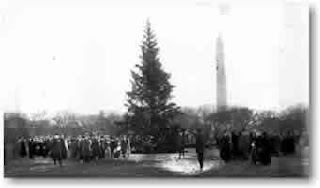
First National Christmas Tree -1923


Tuesday, December 8, 2009

Kitchen Debates Redux


In the early Fifties, shortly before the Nixon-Kruschev Kitchen Debates, the Soviet Union decided to prove that it too could be a consumer society -- that the Dictatorship of the Proletariate could shower goodies on the worker as well as any capitalist trickle-down. Enter GUM


GUM, or the Glavnyi Universalnyi Magazin (Главный Универсальный Магазин), was originally housed in the shell of what had been a 19th century trading mall on Red Square. Once the Soviet Union picked itself up from the devastations of the Great Patriotic War, the mall was converted into a general mass-merchandise mart for the masses.

The range of GUM's goods counted over 30 thousand items, including textiles, ready-made clothes, shoes, knitted and linen goods, kitchenware, household goods, furniture and rugs, furs and headwear, stationery and toys, and recreational goods. Eventually, some specialty food items were included as well. The basic idea was, You can get anything you want at the State Department Store.


And anywhere as well. As the decade wore on and the missle gap closed, branch GUMs opened around the country, diffusing through the vast reaches of Mother Russia all the goods and trinkets the Central Planning Office could order up. Pictures in Soviet Life proudly showed ordinary Russians being... uhm.. as almost American as anyone.

Life Magazine showed us the same pictures, but with a different sub-text. Those poor Russian wannabees! Look at them lining up outside gussied up warehouses to grab what they can carry. Sure it's better than nothing -- even if it is shoddy -- but would you want to live there?


Yesterday, for some reason, I thought of GUM.

.