Wednesday, October 16, 2013

Gleaming Death


We were reading in article in Der Spiegel about how the BRIC countries were overtaking the West in just about everything and about how no city in Europe was on the cutting edge of anything.


This news has been in the wings, as it were, for several years now and we have taken note of the sparkling space-age cities rising up in the vast flat-lands of Asia.  Next to those examples of futuristic modernity, U.S. cities appear hokey if not downright shabby.

 
It is important not to loose sight of what is really going on here.  It is somewhat off the mark to think of Brazil, Russia, India and China as solely national sources of a new vitality. Their prosperity is equally due to capital flows from the West.  European and U.S. companies are investing in these countries.


Bill's Bullshit was that by exporting the dirty jobs to backwater, cheap-labour places like China, India, Pakistan and Malaysia, the United States would be become the gleaming headquarters of the future, full of hi-tech, hi-skill,  hi-paperpushing jobs.  Instead all the gleam and clean fingernails followed the grime.  The paper titles may be parked here (USA) but not much else anymore.


But we are overcome by other, sadder thoughts, when we sit and stare at pictures of these Futurama Cities.  There are no trees.... no chirping birds... no tigers on the prowl... no elephants bathing in pools.  They are vast expanses of gleaming DEATH.


These are cities planned for millions, and for millions with hundred of thousands of cars, driving on grass-killing concrete.  The cities are fed, not by milk from cows grazing on a hill -- as in old backwater Europe or parts of Cascadia -- but from cows debased into milk producing things and "sources" of meat.


All the metal and gleam bespeak an exciting future full of artificial "growth" and the death of Creation as we know it.  Very few people are open to  the necessity  of mandated non-reproduction. The money makers and their beholden policy whores are downright against it.  Close to twenty years ago we sent letters to editors noting the need for a reduction in the number of humans on the planet.  Not one got printed.


What is actually anathema has become orthodoxy. The insane pursuit of endless market growth coupled with unrestrained population growth is an evolutionary derangement which obviously has no cure except its own self-destructive consummation.  Chipsters hope it comes sooner than later.  Humans are simply a blight on the world.   That is an objective fact whether your ego likes it or not.


Tuesday, October 8, 2013

Suffering Beauty

 
We had some thoughts about beauty when we read that,

“A man sat at a metro station in Washington DC and started to play the violin; it was a cold January morning. He played six Bach pieces for about 45 minutes. During that time, since it was rush hour, it was calculated that 1,100 people went through the station, most of them on their way to work.

Three minutes went by, and a middle aged man noticed there was musician playing. He slowed his pace, and stopped for a few seconds, and then hurried up to meet his schedule.

A minute later, the violinist received his first dollar tip: a woman threw the money in the till and without stopping, and continued to walk.

A few minutes later, someone leaned against the wall to listen to him, but the man looked at his watch and started to walk again. Clearly he was late for work.

The one who paid the most attention was a 3 year old boy. His mother tagged him along, hurried, but the kid stopped to look at the violinist. Finally, the mother pushed hard, and the child continued to walk, turning his head all the time. This action was repeated by several other children. All the parents, without exception, forced them to move on.

In the 45 minutes the musician played, only 6 people stopped and stayed for a while. About 20 gave him money, but continued to walk their normal pace. He collected $32. When he finished playing and silence took over, no one noticed it. No one applauded, nor was there any recognition.

No one knew this, but the violinist was Joshua Bell, one of the most talented musicians in the world. He had just played one of the most intricate pieces ever written, on a violin worth $3.5 million dollars.

Two days before his playing in the subway, Joshua Bell sold out at a theater in Boston where the seats averaged $100.

This is a real story. Joshua Bell playing incognito in the metro station was organized by the Washington Post as part of a social experiment about perception, taste, and priorities of people.

The outlines were: in a commonplace environment at an inappropriate hour: Do we perceive beauty? Do we stop to appreciate it? Do we recognize the talent in an unexpected context?

One of the possible conclusions from this experience could be: If we do not have a moment to stop and listen to one of the best musicians in the world playing the best music ever written, how many other things are we missing?”

It was a stunning, if not altogether unknown, reflection of our civilisation and it made us think of Hans Urs von Balthasar, the 20th Century Catholic theologian who wrote.

"We no longer dare to believe in beauty and we make of it a mere appearance in order the more easily to dispose of it. Our situation today shows that beauty demands for itself at least as much courage and decision as do truth and goodness, and she will not allow herself to be separated and banned from her two sisters without taking them along with herself in an act of mysterious vengeance. We can be sure that whoever sneers at her name as if she were the ornament of a bourgeois past — whether he admits it or not — can no longer pray and soon will no longer be able to love"

But this in turn stirred a question in my mind for Mr. Bell.  It is a near certainty that among those who disposed of his music by rushing past it were members of the very same bourgeoisie who would or had paid $100.00 a seat to hear the same piece in a proper setting.  Why would Mr. Bell want to play for them?  

Of course, we understand that Mr. Bell needs to make a living; we all do.  However, anyone who has worked at Bach comes to understand the intimate relationship between player and listener, between (as Bach would certainly put it) score and soul. Once again, von Balthasar,

"Seeing is the organ with which the world is possessed and dominated.  [Perception] denotes distance, separateness and subordination to our perspective.  Hearing is a wholly different, almost an opposite mode of the revelation of reality. ... The basic relationship between the one who hears and that which is heard is thus one of defencelessness on the one side and of communication on the other. The hearer belongs to the other and obeys him."
We cannot pass judgement on every concert goer; but we are confident that those who did not stop to listen were refusing to obey.  Were those same people in one hundred dollar seats hearing music or listening to the mask of technique.  If they were deaf in the Metro are they not also deaf at the Met?  Just how much are we going to surrender to the rationalisations of prioritising?

The surrender involved in listening to Bach seems to explain why the children alone were the only ones who were uncontrolled enough to stop and submit.

Were all these children moved by the sublime profundity of Bach?  Perhaps we ought not to make more of innocence than is wont.  Certainly the music arrested them which is more than it did for their parents.  Once arrested,were the children moved by the sounds or fascinated by box that emitted the sounds or entranced by the gesticulations and motions of the violinist?

In our view it does not make any difference because all these elements were of a piece.  It seems rather to miss the point to fuss over which component was prevalent in any child's awareness. Isn't the point that they were open, defenceless and trusting enough to suffer experience?  Which brought us back again to von Balthasar,

"Whenever the relationship between nature and grace is severed (as happens... where 'faith' and 'knowledge' are constructed as opposites), then the whole of worldly being falls under the dominion of 'knowledge', and the springs and forces of love immanent in the world are overpowered and finally suffocated by science, technology and cybernetics. The result is a world without women, without children, without reverence for love in poverty and humiliation — a world in which power and the profit-margin are the sole criteria, where the disinterested, the useless, the purposeless is despised, persecuted and in the end exterminated — a world in which art itself is forced to wear the mask and features of technique"

Mr. Bell is certainly a "technician" and the whole point of article was that the exquisite features of his technique were ignored by a stampede of humans except for the children whom, we have just said, might not have been all that attuned to his technique.  So was the beauty which Mr. Bell produced, in the end, wasted on all or was the beauty of the matter somewhere else?

Street musicians are a relatively new and still rare  phenomenon in the United States.  Our cities are without centres, have few useless spaces and have been handed over to the stampede of cars.  But there was a place and a time when we grew up where street musicians were commonplace.

Every other or third day, the organ grinder would come onto our street in the late afternoon just before dusk and start cranking out his flutey toones.  "Ayyyyy" the maids would cry as they ran to front windows to throw coins at the music maker.  Coins, i will add, taken from very meagre earnings.  But nothing got done -- for we all stopped whatever we were doing --  until everyone had got their fill of the music. 

And maybe once a month, a band of village peasants would amble onto our block with their cracked violins, battered horns and leaky tubas or patched drums. With an uneven, barely coordinated start they would then crank out their missed beat, out of tune, rasping, flubbering music which was beautiful in its sheer awfulness.  It was never clear that they were not paid to go away but their semblance of music did make us smile and isn't that too the point of music?

And then there was music which made one cry, made perhaps by a grizzled old violinist making a free gift of his rasping melody to the Blessed Virgin, at the foot of the altar.  If the image is paradigmatic it is because it was prevalent; and here i have to say, with no disrespect to Mr. Bell and certainly not to Bach, that there was more beauty in that poverty than in all the mask of technique in the world.


©WCG 2013

Tuesday, September 24, 2013

On the Beggar's Art

     
Beggars were ubiquitous in Mexico, even more so than in today's metastasizing urban sprawl.   They crouched in dirty doorways holding up scrawny hands and pathetically mumbling things like "Ten piedad por amor a nuestra santísima Señora...

They mumbled these mantras so continuously that begging became a sort of meditation, which in a way i suppose it is.   kyrie eleison...

Among beggars there was a sort of rush toward the bottom to see who could be more positively pathetic and wretched.  One wonders if they held a convention somewhere to hand out awards for the "best costume" and "grimmest disability" or "lacrimose lament."

There was one woman who had attained a sort of fame in this respect.  Her "post" was somewhere in the vicinity of Avenida Juarez and Niño Perdido - in a well concoursed older part of downtown.  Almost everyone had passed her at one point or another or so it seemed. Oh wretched art though among women....

And then one day an article appeared in the paper exposing her game.  The woman was indeed a beggar, but she brought in a hefty income.  She had a bank account and sent her children to a private school. 
 
It was of course classic, like the Chaplin or Keystone movie where the veteran amputee on the sidewalk, gets up and stretches his tucked legs at the end of the day.  And like the audience at a Chaplin movie, people read the article, laughed and went on to talk about other good begging acts they had run across.

There was the sense around the table that if you had fallen for the woman's act you had been suckered, which was of course true.  But, at the same time, no one felt that she had committed a cheat or a fraud, which was also true.  After all she was a beggar and that's what beggars do. She could hardly be blamed for being good at her "profession" -- and given the litanies involved it was a profession.

This was a very different attitude from that which prevails in the United States what with all the self-righteous snarling about welfare cheats.  No one felt that our now-famous beggar had been a cheat.  At what exact degree of hunger does misery cease to be a deceptive act?  How many rags are "too many"?

Well she could of gone out and got an honest job....

That refrain which flaps in the north like so many stripes in the wind would simply not have occurred to anyone at the table.  After all, the poor are poor because they are poor. They have no capital: no education, no competence, no skills, nothing to sell for money.   If she could have gotten a job she would have... if jobs were to be had.   Who can trace the what's, why's and wherefore's, except to say,

To he who hath more shall be given; to he who hath not even that which he hath shall be taken away.

There will always be poor because people are born without and because there are never enough jobs for all.   No one in Mexico discounted the value of hard work or talent. But neither did anyone beguile himself with the canard that these alone were sufficient for "success."  Everyone understood that, at bottom, any one person's success is always someone else's gift. There is no such thing as an "honest job." We are all beggars after a fashion.

Quid sum miser tunc dicturus?
Cum vix iustus sit securus?
 Rex tremendæ maiestatis,
Qui salvandos salvas gratis,

 *
 God saves freely,
as even the just are in need of mercy


But this humble circumspection is beyond those who feed upon a hill, and who feel cheated by someone else's need.


©

Wednesday, April 24, 2013

Zeitgeist for a New Century


One way or another, what goes around comes around and it did not take more than ten years for the securitization inflicted on Baghdad to come back and bite the citizens of Boston.

Since 9/11, we chipsters have repeatedly warned against the constabularization of military forces and the militarization of  the police.  We have warned that every wall has two sides and that, of necessity, a war on terrorism over there is  a war on terrorism in here. We warned that the grotesque images of our "post combat stability operations" in Iraq were merely the preview of peacekeeping operations at home.


To no avail.


The logical mind, duly focusing on concrete specifics, will protest that there is "no proven connection" between any bombing in Iraq and the pressure cooker explosion in Boston.  It will argue that the "tragedy" in Boston is an "isolated incident" sprung from the brain of a deranged loner acting from idiocyncratic impulses.  It will point out that the technology and procedures used by the police in Boston are no more connected to the technology and procedures used by peacekeeping forces in Baghdad  than a hammer in Iowa is connected to the use of a hammer in Okinawa.

In all this, l'esprit de geometrie, is specifically correct but fundamentally wrong.  It is not a question of facts but of symptoms.  What is needed is not a delineation of inferences but a perception of Zeitgeist.

Put another way, the fact that a hammer exists in the first place means that people will be hammering in Okinawa as in Iowa.

We were first alerted to the hammer by an 2002 article in the Moscow Times concerning a think-tank paper entitled "Rebuilding America’s Defenses -- Strategy, Forces and Resources for a New Century” (Sep. 2000) which the Times had called America's Mein Kampf and which we have repeatedly analysed and discussed over the past decade.  In actual fact, Hitler's notorious book was no more than a meandering discursive auto-biography. In contrast the PNAC paper was a prescription for total war.

Rebuilding America's Defenses outlined a weltanschauung in which both the means and the ends of American policy was simply and brutally global power projection on land, in the sea, in the air, in "space and cyberspace." 

We have discussed this paper so many times, we are loathe to do it again.  But perhaps the most important thing to grasp about Rebuilding is that it has nothing to do with causes and goals but simply outlines an ontology -- a manner of being.  As George Orwell, famously put it,

"Power is not a means; it is an end. One does not establish a dictatorship in order to safeguard a revolution; one makes the revolution in order to establish the dictatorship. The object of persecution is persecution. The object of torture is torture. The object of power is power."  (1984)
The PNAC paper was a sequel to the still semi-classified Defense Planning Guide, drafted in 1992 by Dick Cheney, Paul Wolfowitz and a cadre of zionist neo-cons whose smudge marks are all over the "securitization" of U.S. domestic and foreign policy.

Although both papers talk vaguely about promoting American "principles and interests" (Rebuilding, p. i) or establishing "democracy and free-market institutions world wide" (D.P.G, p. 1), these phrases are simply passing tissues over a what is simply a naked culture of "forward presence operations" and  "power projection." (D.P.G, p. 10; Rebuilding, p. 20.) 

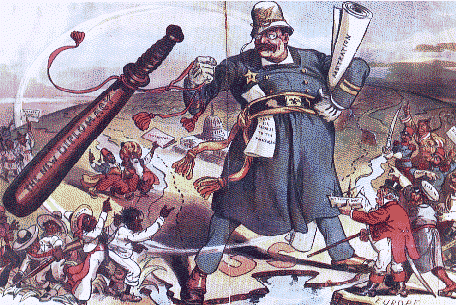
In fairness, "power projection" is nothing particularly new in American policy.  It was the essence of Theodore Roosevelt's Big Stick policy.


But Roosevelt's Big Stick was tied to the achievement specific economic goals. Cheney's neo-con mavens advocate swinging the stick just for the hell of it.

This is not to say that the policy is devoid of political or economic goals. Nothing in life has the abstract neatness of a fictional account. It is to say, rather, that as the policy becomes increasingly entrenched, goals become correspondingly reduced to collateral or incidental benefits. The means simply swallow the ends. The ontological clue can be found in statements that  the potential for any other state to present a threat to American preeminence, becomes the raison d'etre for "preemptive response."

Cheney's Defense Planning Guide explicitly stated that U.S. defense policy needed to "refocus on precluding the emergence of any potential global competitor." (Id., p. 4.) or "of any potentially hostile entity." (Id., p. 26.) Accordingly, defence strategies needed to  maintain "mechanism[s] for deterring potential competitors from even aspiring to a larger regional or global role.  (D.P.G  p. 2.) 

Such a formula is simply the rubric for ongoing kick-ass actions around the world.  The policy is so utterly perverse -- so diabolical in fact -- that even 20 years on, and despite all the allusion's to 1984, most people still do not get it.


"Shaping the security environment" (Rebuilding, pp. iv and 6) in order to deter other countries from even thinking about having some weight and influence in the world is simply a bureau-burble for a strategy of ongoing degradation, debasement, and "negative reinforcement" much the way bullies and abusers intimidate slaves and wives into submission.


It was from this premise, that Cheney's mavens derived their doctrine of what ultimately came to be called a full spectrum military.

Since a "potential threat" can arise in any number of different ways, it becomes necessary for America to have the capacity to respond or preempt that threat in as many different ways.  While some enemies might confront us on a field of battle, with flags a-fluttering; others might potentially endanger us by means of subversive agents and "Fifth Columns."

Accordingly, Cheney's memorandum and the PNAC paper outlined a full range of strategies for meeting these potential threats from "space to cyberspace." (Rebuilding, p. 27.) The inevitable result is the militarisation of civil society. Just as the military would have to engage in so-called "constabulary" operations abroad, the domestic police would have to engage in military operations at home.  The only difference between a soldier and a sheriff would be the colour of the uniform.

Among the missions of the new full spectrum military, the PNAC paper listed something it called "post-combat stability operations." If one's ear does not burn, he is not atuned to the times.

Traditional military "operations" are comprised of invasions and battles. Maintaining law and order in the aftermath of war, while a responsibility of the occupying power, has never been regarded as a military operation. The use of the word "operation" in connection with "stability" pointed to a peculiar proactive peacekeeping which was in actuality simply a lower level of war.  As Rebuilding itself put it, these "post-combat" actions were "lesser included" operations of sustained traditional infantry missions.

Of course, in such a case, there is no "post" to anything.  "Post combat" is just Orwellian double-think for ongoing combat operations. Keeping the peace is simply a form of war.  It was for this reason that the PNAC paper frankly acknowledged that "constabulary missions" were "likely" to "generate" violence. (Rebuilding, p. 11.)

What kind of world is it where peacekeeping generates violence?  It is a world in which mili-cops engage in the the use of "organic intelligence units," the "acquisition and management of information," in "political-military environments" including the "battlefied of the internet."  As needed "skin patch pharmaceuticals" will be employed to enable soldiers to to perform and cope with these expectedly high-stress missions.

All of the phrases in quotes are taken from the PNAC's dystopian blueprint.  Stripped of their bureaucratic varnish, they betoken a world of spies, provocateurs, recorded surveillance of public and supposedly private venues, data mining, censorship and propaganda within an overall context of force and violence.

Such a full-spectrum strategy is not calculated to bring about any wholesome result.  It is designed to do what it in fact does, which is to degrade civil society, or as the PNAC refers to it, the "security zone." 
 
Within the terms of this policy, Iraq and Afghanistan are not failures but successes.  The rubble that passes for "democratisation" is the intended result, because the destruction of the country's political infrastructure and national cohesion incapacitates the possibility of nationhood and with it the "potential" to present a threat. By the same token, it exposes the once nation to ad hoc exploitation (aka "investment") of the region's natural resources.

It is mistake to fall for the euphemisms. Whenever Cheney or Bush or Obama or anyone else speak of combating terrorism, democratisation and open markets they are referring to a policy of political incapacitation and economic penetration.

It is equally a fatal mistake to imagine that this policy of power projection and zonal degradation is something that takes place "out" there and not "in" here.  In the PNAC blueprint, places like Lithuania, Iraq, Afghanistan and South Korea are simply the America's security "perimeter."  Within the  “security-based” mentality, “security” begins at home and the Homeland is the preeminent zone of democratic peace,  requiring its security environment to be shaped as much as any other.

It is a lazy misconception to think that all those nasty things taking place abroad are the price they pay so that we can "enjoy the fruits of freedom" at home.  To think as much is to think teleologically whereas, as we have said, the policy is ontological and aims to practice security at home as well abroad.

Lastly, it is important not to loose sight of the imbecility induced by double-talk phrases like "potential threat." The word "threat" means a possible or potential harm. Thus a potential threat means a possible possibility of harm.  To say that the police are tasked with protecting us from an evil which is twice removed from any present reality is to render everyone a "potential suspect." 

It is astonishing the unthinking carelessness with which pundits, politicians, jurists and academics use destructive pleonasms like "potential threat" or "potential suspects."  The effect of such phrases on the infrastructure of thought is as devastating as an atom bomb on the infrastructure of a city.

Strictly speaking such redundancies mean nothing. But the poison lies in the fact that they induce the sense that nothing contains something.   A potential threat "exists" (we've just mentioned it, right?) even if it is unseen, unknown, unspecified.  Given that it is "exists" (as a potential) we must take action against it even if it there is no evidence of  any specific "threat" (i.e. the potential).  Given that the potential threat is inchoate action against it encompasses countermeasures against any arbitrarily asserted possible potential.

It was thus that back in 2008, CIA chief McConnel informed Congress that the "enemy" had "acquired" the capacity to "blend in" with the rest of us.  Of course the enemy had "acquired" no such capacity.  Suits, jeans and baseball caps have been around for quite some time.  McConnell's discovery was simply the realization of what it means to say that we are all potential suspects.  As Pogo famously put it:  We have met the enemy and he is us.

Enthralled to such destructive constructs, two successive Administrations have already sought to dispense with constitutional limits on data mining all currently available information on U.S. citizens. Law Enforcement is already at work erecting security perimeters and audio/video monitors around and within the country. Police agencies of every type are already “organically” penetrating alleged “suspect” and “target” groups, without ever specifying exactly what makes them suspect and, once an arrest is made, the alleged criminal conduct more often than not has all the clarity of an entrapment sting.

The notion that the State should “control” the internet and wage net-war on it, basically extends power projection and security shaping into the realm of information and thought. This has nothing to do with preventing a possible terrorist act or even sleuthing it after the fact.  It has everything to do with disorienting the capacity for grounded reflection.  Like a person spun around to the point of staggering dizziness, disinformed society is one that simply cannot function as social organism; it is simply humanoid putty.

However, as Plato might remark, the civic constitution is simply a mirror of the human soul, so that the corruption of one becomes the corruption of the other.  It was therefor hardly surprising the PNAC's American Kampf ended with a Strangelovian orgasm forseeing the day when

"Future soldiers may operate in encapsulated, climate-controlled, powered fighting suits, ... “and  [s]kin patch” pharmaceuticals help regulate fears, focus concentration and enhance endurance and strength."
Such "regulation" is required because the human conscience rebels against inhumanity and there comes a point when even brutalization no longer works sufficiently. This is particularly the case when the enemy alien is replaced with the suspect neighbour.


It follows that if the America's rulers are willing to turn U.S. soldiers into drugged up killers, they will see no objection to pharmaceutically enhancing domestic security forces. All the images we see in Guantánamo, Afghanistan and Iraq today are a foretaste of the Homeland tomorrow.  It will be so.


The denouement was foreseeable at least since the first kevlar-encased cops began appearing on our streets after 9/11.  But it goes deeper than that.  No cancer seizes hold without a precursor of bad habits. Beyond mephisto-phelian memoranda, the degradation and brutalizing of American civil society has its roots in a culture of aggression and avarice; in the worship of success and hardness.

Why do people love flowers?  Because they are beautiful, soft, fragile and helpless. These are the qualities that inhere in their beauty. The theologian Hans Urs Von Balthasar put it this way

"[When] the whole of worldly being falls under the dominion of 'knowledge', and the springs and forces of love immanent in the world are overpowered and finally suffocated by science, technology and cybernetics,  [t]he result is a world without women, without children, without reverence for love in poverty and humiliation – a world in which power and the profit-margin are the sole criteria, where the disinterested, the useless, the purposeless is despised, persecuted and in the end exterminated ..." (Love Alone pp. 114-15.)
In the United States, flowers are a commodity you give mothers, wives and girls to keep the peace, before going back to being tuff among men. Power projections and profit-margins which are two hydra-heads of the same impulse have long been the most salient characteristic of U.S. culture.  This is not to say that the impulses of power and profit have not existed elsewhere or in other times.  Nor is it to say love of beauty does not exist in America.  All cultures rest on a fulcrum between beauty and the brute. But in the United States brutishness has been turned into a cult which overrides and will eventually extinguish other values.

The most obvious manifestation of the cult is our cultural worship of hardness, action and militarism-as-sport.  This is not simply a question of "gun violence."  It is rather a question of an impatience or contempt for what is soft and at-rest. 

The banner of women's liberation in the 60's was "we are just as good as men" -- a motto which implicitly accepted that there was nothing more contemptible than to act "just like a woman."  It took 30 years before it dawned on them that femininity was an inherent virtue in itself; but by then the disconnect was so pronounced women had only the a false, fantasmagorical and equally exagerated notion of what "feminine" really is.  Emphatically heterosexual as American culture is, it basically hates women.

But men fare no better.  The idealisation of a hyper masculinity which is impossible to achieve renders men mere spectators of an alienated self they shamefully feel they ought to be.  The performance deficit is made up with a full spectrum of pseudo combat activity from junk car racing, to paint-ball to football, most of which ends up being a mere spectator sport.  The brutalisation of the American male psyche is so complete that the average male secretly worships the hyper-robocop that comes astompin' on him.  It is trés gai.

This is not to deny that men, by nature, have hormonally aggressive impulses which are best channelled and displaced.  It rather to say that aggressive impulses which include the desire to penetrate into things and to accomplish a result are not limited to forms of destructive violence but also manifest themselves in action which is quiet and creative.  Instead, a technological, consumer culture of aggresive and primitively domineering action is cultivated.

The failure of reverence occurs in subtly and seemingly innocuous ways; as for instance when excursions into our magnificent outdoors becomes the occasion for equipping and endurance contests.  What is really occurring is a technocratizing of the simple beyond what is minimally necessary, so that the means crowd out the end. Thus, whereas Saint Francis walked El Camino barefoot, techno-man fusses over which is the lightest, strongest, most aeriated  walking boot.  In the end, the pilgrimage gets turned into: "Do the Camino on Bike!"

The brutishness of American culture at all levels is unbalanced and unremitting.  It has been perhaps since its inception and was something Alexis de Tocqueville commented on, in various contexts, in his great work Democracy in America.   In so saying, I do not mean to suggest that the issue is solely a sociological one concerning "cultural attitudes."   On the contrary, the driving force behind the cult of power is a specific kind of political-economic based on profit margins.   I mean only to focus on the psychological attitudes and the strategic methods employed and necessitated by an economic system.


It is not psychologically susprising that despite all the worship of brutishness, Americans themselves are actually scared and cowardly.  This is hardly a mystery.  The addiction to anything which is inherently false produces the opposite effect of that sought. As Gibbon repeatedly noted in his history of Rome's decline, displays of power became the cover for an enervated expectation of security.  We have become a Ninnie Nation, and Official Brutishness is simply the compensatory circus.

The Emperor Honorius, who spent his days tending chickens was no more a general in the field than George Bush, surrounded by chickenhawks in the palace, was a  fighter pilot.  But the cultivated and obligatiory image of hardness was presented as a form of vicarious exercise to a supine public which is convinced it is the deserving master of the world.

It is through this lens that the events in Boston need to be viewed.  The issue presented by the Boston Bombing is not whether the alleged suspects acted alone, in connection with terrorist group or whether they were the patsies or scapegoats of a false flag operation (as some blogs have inevitably theorised).  The issue presented by the Boston Bombing is not whether it was necessary to search for the culprits or whether the city was or was not under partial or total, de jure or de facto lockdown.  Other times and other places have survived a declaration of martial law.  The issue is the stick which lies in waiting.

In a sense the United States is already the perfect paradigm of the degraded zones of democratic freedom we are securing and extending abroad. 

Overseas we must inflict power projections and post-combat operations in order to induce a despairing, submissive, lumpen attitude which does not even aspire to self-realisation.  In the United States the process has evolved in reverse.  Over time and especially since the World War, our culture had induced a acquiescent, misinformed lumpen attitude which, while drunkenly thinking of itself as living in the land of the free and home of the brave, actually begs to feel the projection of power during post-crime operations.

The heteronomous result is that not only are the good citizens of Boston demanding more surveillance cameras they are reassured when armed mili-cops come pounding on their doors demanding entry.  Few Americans and even fewer Bostonians were appalled at the sight of militarised police conducting post-event stability operations in the same manner as was done in Baghdad.  If one asks why, the answer must be that the brutalisation of the American psyche is already so complete it welcomes the degradation which has already been achieved.



Saturday, March 16, 2013

Spitting On an Outstretched Hand


It is amusing -- in a spitting sort of way -- to watch the media and bloggerati speculate whether Pope Francis will alter the Church's stance on homosexuality.  That some should even ask reflects a childish incomprehension as to what the Church is and how it operates.  That others should caution not to expect an "overnight" change leaves one wondering what happened to their voice of moderation during Benedict's tenure.

We have written at length, before and elsewhere, on how Benedict was laying the groundwork for a radical repositioning of the Church's teaching on sexuality.  To summarise very briefly,

Benedict's first encyclical, Deus Caritas Est, was on love. Within the first few paragraphs he managed to quote Nietszche and allude to Aristophanes.  To anyone familiar with what Aristophanes had had to say about love -- and about the three sexes --  it was the hint of a clanging gong.

But Benedict did not leave it at  hints.  In the ensuing paragraphs he espoused the doctrine of "ascending love" which naturally begins in eros and matures into mutual caring. "The essential nature of love," he wrote, is "a journey, an ongoing exodus out of the closed inward-looking self towards its liberation through self-giving, and thus towards authentic self-discovery" (Deus Caritas Est., § 6.) If eros is merely the enticement that pulls us out of ourselves, what possible difference does it make if a person is led to care for one of the same or the opposite sex? None. In the Christian lexicon, caritas, agape, "love," is absolutely not gender-conditioned.

It is within this context, that what Benedict omitted to say was as significant as what he did  say.  Nowhere did he quote from Humanae Vitae, the previously enunciated doctrine that the redeeming purpose of sex is to transmit life.  While Benedict did acknowledge that matrimony between man and woman "tends" toward the transmission of life, in the next breath he went on to caution that  love should not be "relegated to the purely biological sphere." (Deus Caritas Est, § 5.)

At least as critical was Benedict's volte face on relevant Scriptural passages.  Anyone knows that the Christian condemnation of homosexual acts is based on Corinthians 6:9, Romans 1:18-32 and  Leviticus 18:22 and 20:13.  Ghost writing for John Paul II,  then cardinal Ratzinger certainly knew the drill. But as pope, Benedict interpreted these passages as condemnations against ecstatic fertility cults in which humans were "exploited" as mere "means of arousing divine madness."  That was a very different (and essentially liberal) reading of the passages.

But it is on the reading of Scripture generally that Benedict showed his true colours. In the Introduction to his book “Jesus of Nazareth” (Ignatius Press, 2007), Benedict took as his premise that historical criticism was “indispensible” to Biblical exegesis. (Op. Cit., p. xv.) "A voice greater than man’s echoes in Scripture’s human words; the individual writings [Schrifte] of the Bible point somehow to the living process that shapes the one Scripture [Schrift].” (Op. Cit., p. xviii.) Thus, he continues, the Bible “does not speak as a self-contained subject” but “in a living community... in a living historical movement."  The writings in the Bible "become Scripture by being read anew, evolving in continuity with their original sense, tacitly corrected and given added depth and breadth of meaning."

In so saying Benedict was not so much being a "radical" as a tradtionalist in the true sense of espousing change within continuity.  The Church is not guided by a merely present consensus on things, like a political party.  It is a trans-generational community of "saints" whose experiences and inspirations are all alive in the present which shapes the past as it is shaped by it.

A cycnic may be excused a smile at the notion of "tacit corrections" by "deeper understandings."  But the process is not one of rhetorical exploitation for present purposes.  Traditionalism has to be practiced in good faith with circumspection and constraint; but it does seek to evolve, permute and change.

I cannot but view these writings of Benedict's as other than an invitation to participate in a movement toward a deeper understanding of human love -- one that transcended (without denying) the biological and aimed at loss of ego in caring for another.  But the liberal Catholics and the majoritairan gay community spat in his hand.

Not only that, but in its incessant drumbeat the media fabricated out of whole cloth "condemnations" which Benedict never uttered.  Of course, Benedict publicly urged support for the heterosexual family.  Why wouldn't he?  Most of the world is heterosexual and the Church must speak for them.  But he was very cautious not cast that support in dichotomous terms.

In January 2012, Benedict spoke of social settings necessary for personal and social development. Of these, he said, "pride of place goes to the family, based on the marriage of a man and a woman."   The phrase "pride of place" necessarily implied other places.  How this got translated into the screeching headling "Pope says Homosexuality Imperils Civilization"  is any monkey's guess.

Alas, three months later, "pride of place"  gave way to language cribbed directly from Humanae Vitae.  Matrimony, the pope said was  "essentially rooted in the complementarity of the sexes and oriented to procreation." 

People we talked to, who are more in tune with subterranean currents at the Vatican, were convinced that Benedict had been ambushed by conservatives on his speech writing staff.  But ambushed or not, the media turned it into a kill.  The pope delivers scores of homilies, addresses and greetings in any given week -- all chock full of pre-approved phrases and researched references. While they are not "meaningless" they do not involve the careful word-weighing process that goes into an encyclical and for that reason do not carry much doctrinal weight.  But the Hate Benedict Crowd -- as if needing a bugbear for their own self-definition -- treated it as the bull of the century and drove the nail into the very change they avowedly sought.

Nine months later, an exhausted Benedict resigned.    He has been replaced by a "humble" pope who in all humility has said that gay matrimony is an affront to God.  That's the kind of  crime against nature language that reverts back to the 19th century.   Tacit corrections?  Not likely.


.


Saturday, March 9, 2013

An Embracing Plunge


Someone posted the video of a baby elephant joyously discovering and frolicking in the surf.


Two quotes came to mind as I watched  with tenderness and affection the frolick of this fellow creature. 


"Eternity is not an unending succession of days  but  something more like the supreme moment of satisfaction, in which totality embraces us and we embrace totality—this we can only attempt. It would be like plunging into the ocean of infinite love, a moment in which time—the before and after—no longer exists." (Pope Benedict XVI,   Spe Salvi, § 12.)

And from Schiller's Ode to Joy,

 Freude trinken alle Wesen  All creatures drink Joy
 An den Bruesten der Natur, At nature's bosom;
Wollust ward dem Wurm gegeben,  Pleasure was given (even) to the worm,
Und der Cherub steht vor Gott.  And the Cherub stands before God.


At the same time it painfully saddened me to think that this beauty is being exterminated by man's avarice and this made me think of Hans Urs von Balthasar,

"Whenever the relationship between nature and grace is severed (as happens... where 'faith' and 'knowledge' are constructed as opposites), then the whole of worldly being falls under the dominion of 'knowledge', and the springs and forces of love immanent in the world are overpowered and finally suffocated by science, technology and cybernetics. The result is a world without women, without children, without reverence for love in poverty and humiliation — a world in which power and the profit-margin are the sole criteria, where the disinterested, the useless, the purposeless is despised, persecuted and in the end exterminated .... " (Love Alone pp. 114-15).  

With all my heart I wish this baby elephant well and many happy frolicks. 


Tuesday, February 26, 2013

A Revolutionary Resignation

Pope Benedict's announced resignation has triggered a lot of political speculation and some theological consternation.

From a theological perspective, the question of whether a pope can resign depends on whether he is viewed as the vicar or the image of Christ.  If he is only a vicarious agent of Christ then his position is fundamentally a question of management which can be handed over at any time.  If, however, he is the representational image of Christ, then following in his footsteps, a pope cannot resign from the Cross.

Pope Benedict's concise statement of resignation explicitly recognised the distinction.  He began by stating that the papacy "due to its essential[ly] spiritual nature, must be carried out not only with words and deeds, but no less with prayer and suffering."  This was an express acknowledgement that the cardinal office of the Pope is to suffer representationally of Christ as Jesus suffered representantionally for Mankind.  In short, the papacy is a spiritual sacrifice.  And yet, in his next breath and repeatedly throughout the statement, Benedict referred to the papacy as a "ministry" a word laden with more Protestant notions of trusteeship and stewardship.

Pope Benedict's resignation manifested the latter perspective and was therefore fraught with revolutionary doctrinal implications. 

The idea that a priest is the representational image of Christ is the springboard for both celibacy and the exclusion of women from the priesthood.  As cardinal, Benedict  himself put it succinctly: women could not be ordained as priests "because Jesus was a man."  Jesus was also celibate, according to tradition. 

There is an arguable distinction between the priesthood as such and the office of pope.  One must be a priest to become a pope, so that the representational imagery of the priesthood is something that pre-exists pope-hood.  It follows that the office of pope is not that which brings or bears the element of representational imagery to a person. It already inheres in the priestly office and is nothing brought by the papacy as such.  On this basis, it could be argued that whereas a person, as pope, is not the image of Christ, a priest as such is.  But this argument, aside from being overly clever, runs into a host of  problems, not the least of which is the retirement and/or defrocking of priests. 

The plain fact is that by resigning, Benedict has consigned to history the notion that a pope cannot resign because he is the image of Christ, who did not "retire" from the Cross.  Once this decoupling is accepted there becomes ever less reason to insist on celibacy or to deny women the priesthood.

We, ourselves, are not convinced this was a well-advised move but we are certain Benedict was well aware of its implications.

As usual, Benedict is subtle and perhaps too subtle for a world (and Church) filled with braying dolts.  Noisiest among the dolts are the liberal Catholics and secular non-Catholics (which are much the same thing) prattling about the "scandals" that beset Benedict's papacy, his undeviating attempts to turn the clock back on Vatican Two, his relentless opposition to women and homosexuals, his botched outreach to Muslims and (despite his Rottweilerian instincts) his enfeebled incapacity to control the Curia and, at last, the opportunity which his courageous (or at least welcome) resignation presents for cleansing, reform and change ---  all of which simply reflects the discontent and panting of their own desires.

One wonders if anyone in this crowd ever read anything Benedict wrote and if they read it whether they had the erudition and capacity for reflection to understand it.

It has been our view, that Benedict was a tempered reformer.  He was, in his professional youth, part of the so-called "liberal" wing  of the Church.  But within the first decade after Vatican II, Benedict saw that the process had unmoored the Church, casting it afloat on the choppy waters of personal opinion, situational relevance and, worst of all, liturgical kitsch. 

But it is equally the case, that Benedict rejected the dead-end fetishism of the SSPX and those "traditionalists" who insisted on remaining precisely adherent to tried and inherited norms. He struggled to make room for their practices without surrendering to their insistences.

Benedict came to see the true nature of tradition as comprising of change within continuity and involving "tacit corrections" (his phrase) of unerring doctrine.  That is not the language of what people nowadays call a "conservative."

But the idea that we each see "the right, as God gives us to see the right" is fundamentally a Protestant error which leads to alienation and disoriented extremes.  "Room for all under the tent" misconceives who the all of us is.   

Faith, Benedict has said on more than one occasion, is not personal and subjective but communal and performative.   But this community -- the whole  Body of Christ --  includes the seen and the unseen, vivos et mortuous -- now. The Church lives within an eternal present which is not eternally static but eternally ever growing larger as more and more faithful are born and added to the host of Heaven.

We cannot ignore what those who got here before us had to say.  Nor can we (like modern day lawyers) mine what they said for nuggets of "precedent" and "dicta" favourable to our own aims and desires.  Even less in an effort to be innovative or Reformist can we "go back" to some fantasised original state of early Christianhood because such a return can only result in a grotesque (and ultimately pathological) parody.  As an astonished Mussolini once told Hitler, "(mio caro Adolfo) you can be like a pagan but it is impossible for you to be a pagan."

In practicing doctrine, we must not only "consider" by-gone theologians and philosophers as if they were the subjects of a doctrinal anthropology.  We must walk and talk with them by means of imaginary dialogues in which we play both parts of the conversation.  And to keep our own selves in check we must do this together with others in the here and now. This is not done by "bringing the Church up to date" or by abrupt, habit-breaking corrections under the banners of necessity and relevance and inclusion.  It is a a slow, evolutionary and organic process which equally honours continuity-community-change in the ever present.

It is our belief that Benedict viewed the matter thus and was accordingly laying the patient groundwork for organic but solid and lasting change.  It is a shame that he his great gifts were ignorned by hot-heads and fusspots each operating from their respective repressions, guilts and self-love.   It  is equally a shame that the Church's exit from her present deadlock is left to the  expedient calculations, ambitious machinations and bald hypocricies of fattened eunuchs who could stand some hungering and humiliation.

We are not sanguine about it, but perhaps Benedict will be more widely appreciated once he is out of office. Perhaps too, his resignation was simply a matter of exhaustion.  But even if it was, we cannot believe he was impervious to its far-reaching implications on which he managed not to shut the door.

©